
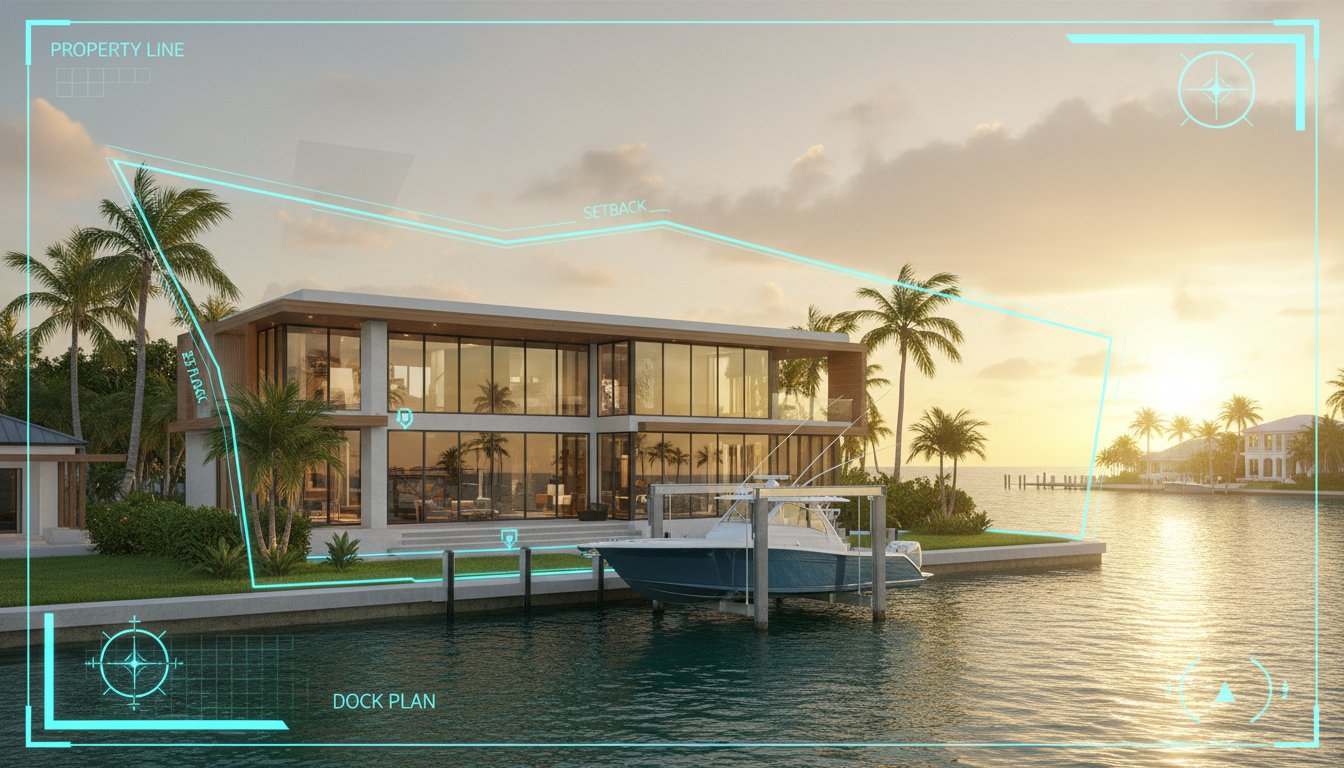
In the Florida Keys, you aren't simply purchasing a luxury home; you're acquiring a complex "bundle of rights" that dictates every aspect of your waterfront lifestyle. It's a unique environment where the dream of a private dock or a custom renovation hinges on a sophisticated understanding of Florida Keys waterfront property regulations for buyers. Have you ever worried that your perfect estate might actually be unrenovatable due to overlapping federal and local laws? You're right to be cautious. The regulatory landscape here is more intricate than anywhere else in the state. Missing a single detail regarding the FEMA 50% rule or ROGO allocations can have significant financial consequences.
We believe you deserve a roadmap that replaces confusion with confidence. This 2026 guide provides the essential due diligence steps to protect your investment and ensure your property supports your specific boating needs. We will explore the impact of Senate Bill 180 on building rights, the specific setbacks required for boat lifts, and how the new living shoreline legislation might fast-track your permitting process. You'll gain the expert insight needed to secure your piece of paradise with absolute certainty.
Key Takeaways
- Identify the three tiers of authority governing your shoreline to ensure you never overlook a critical federal or state permit.
- Master the Florida Keys waterfront property regulations for buyers to determine if a specific property supports your desired boat lift and dockage configuration.
- Protect your capital by understanding the FEMA 50% Rule, which determines if your planned renovation is legally and financially viable.
- Gain clarity on ROGO exemptions and building permit allocations to ensure your investment includes the necessary development rights for future growth.
- Learn why a specialized local network of land-use experts is the ultimate advantage when acquiring high-end estates in the Upper Keys.
The Regulatory Landscape of Florida Keys Waterfront Real Estate
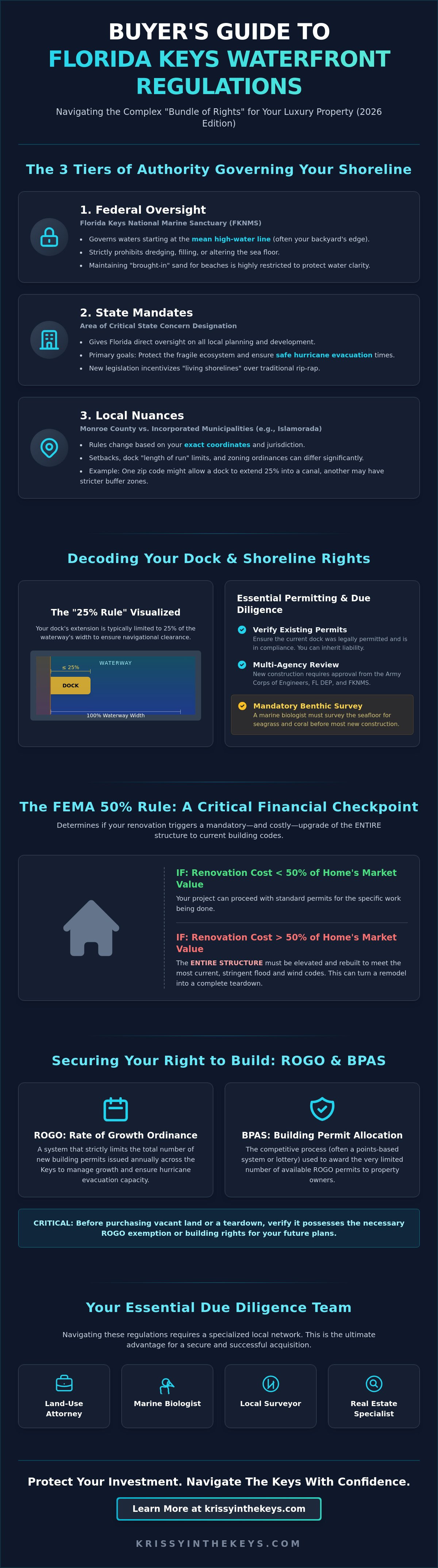
Buying a home in the Florida Keys is a pursuit of a specific, sun-drenched lifestyle. However, it's also a significant legal undertaking. Unlike typical coastal markets, our islands operate within a multi-layered ecosystem of environmental and construction laws. Understanding Florida Keys waterfront property regulations for buyers is about more than just knowing where you can build; it's about recognizing that you are purchasing a "bundle of rights" heavily influenced by the state's "Area of Critical State Concern" designation. This status means that the state of Florida maintains direct oversight over local planning to protect our fragile environment and ensure safe hurricane evacuation times. You aren't just answering to a local building department; you're navigating a hierarchy that includes federal, state, and local authorities.
As we move through 2026, the regulatory environment continues to evolve. The Monroe County government manages the zoning for unincorporated areas, but their decisions must align with strict state mandates. Recent updates to the Florida Keys National Marine Sanctuary management plan have further refined how we interact with the water's edge. This means that due diligence is no longer optional. It's the foundation of a secure investment. Whether you're looking at a sprawling estate in Tavernier or a chic villa in Islamorada, the rules change based on your exact coordinates.
Federal Oversight: The Florida Keys National Marine Sanctuary
The Sanctuary isn't just a park; it's a federal entity that governs almost all the water surrounding our islands. The shoreward boundary often begins at the mean high-water line, meaning your backyard literally touches federal jurisdiction. Federal Florida Keys waterfront property regulations for buyers strictly prohibit dredging, filling, or altering the sea floor without extensive multi-agency approval. Do you dream of a sandy beach? You'll likely find that maintaining "brought-in" sand is restricted to protect water clarity. Even traditional rip-rap shoreline stabilization is being passed over in favor of "living shorelines," which are now incentivized under 2026 state legislation.
Monroe County vs. Incorporated Islamorada
Local nuance is where many buyers find themselves confused. If your property is in Tavernier, you follow Monroe County’s code. If you cross the line into the Village of Islands, you're subject to Islamorada’s specific ordinances. These differences are stark. Islamorada often requires more significant setbacks for oceanfront estates to protect the shoreline's visual integrity. Furthermore, your dockage "length of run" limits, which determine how much of your shoreline can be occupied by a boat, vary by municipality. One zip code might allow a dock to extend 25% into a canal, while another might have stricter shoreline buffer zones that prevent any construction within 20 feet of the water.
Dockage, Davits, and Shoreline Permitting Requirements
Securing a home with a private dock is often the primary goal for those entering the island market. However, the water's edge is where Florida Keys waterfront property regulations for buyers become most visible and complex. You aren't just building a platform; you're navigating a multi-agency review process involving the Florida Department of Environmental Protection, the U.S. Army Corps of Engineers, and the Florida Keys National Marine Sanctuary. A critical constraint is the "25% Rule," which typically limits a dock's extension to no more than one-quarter of the width of the waterway. If you're eyeing a narrow canal, this math determines if your preferred vessel will actually fit at the slip without obstructing navigation.
Before you close on a property, you must verify the status of existing dockage. Do the seller's permits automatically become yours? Usually, yes, but only if they were properly recorded and remain in compliance. If a dock was built without the necessary benthic survey to map seagrass and coral, you might inherit a legal liability rather than a boating asset. The Monroe County Building Department requires these surveys by qualified marine biologists for almost any new waterfront construction. It's a methodical process that ensures your lifestyle doesn't come at the expense of our delicate marine ecosystem. For those seeking expert buyer representation for luxury estates, having a partner who understands these nuances is invaluable.
Manatee Protection Zones and Boating Access
Your commute to the reef is dictated by more than just your engine's horsepower. Many luxury estates are located within Manatee Protection Zones, requiring "Idle Speed" or "No Wake" transit. This can add significant time to your journey. Additionally, installing boat lifts or davits requires strict adherence to setbacks. For instance, stationary lifts must be at least 7.5 feet from side property lines, while floating platforms require a 10-foot buffer. These rules prevent overcrowding in shared waterways and ensure every neighbor maintains fair access to the channel.
Environmental Buffers and Mangrove Trimming
The shoreline setback is a sacred boundary in the Keys. You generally cannot build permanent structures right up to the water's edge, as these buffer zones protect water quality and provide habitat. Mangroves are a vital part of this defense. While they may block a view, trimming them is strictly regulated by state law. DIY trimming is a recipe for heavy fines; instead, you'll need professional permits and often a mitigation fee if you plan to alter protected vegetation. As of July 1, 2026, new legislation under Senate Bill 302 also encourages "living shorelines," offering a faster permitting track for those who choose nature-based protection over concrete seawalls.
The FEMA 50% Rule and Coastal Construction Control Line (CCCL)
Your dream of a coastal renovation hinges on a single mathematical calculation: the Substantial Improvement rule. Often called the FEMA 50% Rule, this regulation is a cornerstone of Florida Keys waterfront property regulations for buyers. It dictates that if the cost of improvements or repairs to a home in a flood zone equals or exceeds 50% of the structure's market value, the entire building must be brought into compliance with current flood codes. For an older, ground-level estate, this often means the house must be physically elevated, a process that is both complex and costly. It's vital to remember that this 50% threshold is calculated based on the structure's market value only; the value of the land is strictly excluded from the math.
As of 2026, these costs are tracked over a rolling 12-month window. This cumulative approach prevents owners from splitting one large renovation into several smaller permits to stay under the limit. Furthermore, your flood map designation determines the severity of these requirements. Properties in V-Zones (Velocity Zones) face the strictest codes because they're subject to wave action during storms. Homes in A-Zones still require significant flood-proofing, but the construction standards are slightly different. Understanding where your luxury build sits on the latest FEMA maps is an essential step in your due diligence process.
Navigating Substantial Improvements
Strategic planning is the only way to modernize an older waterfront home without triggering a mandatory elevation. You must account for every dollar spent on labor, materials, and even overhead, as all these count toward the 50% limit. We always recommend that buyers obtain a private appraisal from a specialist familiar with the Keys market. A standard tax assessment might undervalue the structure, leaving you with a smaller renovation "budget" than you actually have. Getting this number right before you close ensures your investment remains viable and your renovation dreams don't hit a regulatory wall.
Building Oceanfront: The CCCL Permit Process
For those looking at breathtaking oceanfront estates, the Coastal Construction Control Line (CCCL) Program adds a state-level layer of review. Any work seaward of this line requires a Florida Department of Environmental Protection permit to ensure the beach and dune system are protected. This includes everything from new pool installations to beach replenishment. If you're adding sand to your private beach, it must meet the "sand-source" rule, matching the color and grain size of the native environment. Additionally, all new oceanfront construction must utilize high-performance, impact-resistant windows and doors to meet the rigorous coastal building codes of 2026.
ROGO, BPAS, and Development Rights for Waterfront Land
In the Florida Keys, owning a piece of the shoreline doesn't automatically grant you the right to build on it. This is perhaps the most startling realization for new investors. Every residential dwelling is governed by the Rate of Growth Ordinance (ROGO) or the Building Permit Allocation System (BPAS). These systems act as a strict queue, managing development to ensure our islands can be safely evacuated during emergencies. For anyone studying Florida Keys waterfront property regulations for buyers, it's vital to understand that you're often purchasing a "building right" rather than just physical real estate. These rights are the most valuable currency in our local market.
Many luxury buyers prefer a "tear-down" strategy to bypass the lengthy allocation waitlist. By purchasing an existing home, even a modest cottage, you inherit a "marketable" ROGO exemption. This allows you to replace the older structure with a modern estate, provided you stay within the footprint and density rules. However, if you choose the path of vacant land in 2026, you're entering a highly competitive arena where development rights are at an all-time premium. Vacant lots without an existing allocation require a deep level of scrutiny before you ever sign a contract.
The ROGO Point System
Winning a building permit is a matter of points, not just patience. Your score depends on lot size, location, and the environmental sensitivity of the land. High-quality habitats like tropical hardwood hammocks or wetlands earn fewer points, making development more difficult. As of January 2026, the landscape has shifted due to Senate Bill 180. This legislation introduced an initial batch of 300 new building rights, made possible by increasing the official hurricane evacuation clearance time to 24.5 hours. While this provides some relief, these rights are distributed over a decade, ensuring that the scarcity of new construction remains a defining feature of the market.
Due Diligence for Vacant Waterfront Lots
Never buy vacant land in the Keys based on a handshake or a pretty view. A "Biological Assessment" is your first requirement; a specialist must determine what species call your lot home. If protected flora or fauna are present, your building envelope may shrink significantly. You also need a "Letter of Interpretation" from the county or municipality. This document is non-negotiable, as it provides the official word on your property's development potential and point status. If you're considering a high-stakes investment, you need advanced and proven negotiating skills to secure a property with verified development rights that support your vision.
The Krissy Advantage: Expert Navigation in the Upper Keys
Success in the Upper Keys real estate market requires more than just an eye for aesthetic beauty; it demands a granular understanding of how local geography intersects with law. From the winding canals of Key Largo to the prestigious oceanfront estates of Islamorada, the rules change with every mile marker. We approach luxury real estate as your "Authoritative Local Expert," providing the academic rigor and practical experience necessary to safeguard your investment. Our deep-rooted community integration gives you access to a vetted network of land-use attorneys, marine biologists, and specialized surveyors who understand the specific hurdles of our island chain.
We don't just show properties; we conduct a rigorous defense of your interests. We ensure that strict adherence to Florida Keys waterfront property regulations for buyers is a primary closing condition. This means vetting every property for hidden "Code Compliance" liens or unresolved permitting issues that could stall your future plans. By positioning ourselves as your dedicated advocate, we use our advanced and proven negotiating skills to ensure that the "bundle of rights" you're purchasing is exactly what you expect it to be. Our goal is to replace the stress of uncertainty with the confidence of a well-executed plan.
Tailored Buyer Representation
Boating is at the heart of the Keys lifestyle, but not every canal is created equal. We provide tailored buyer representation for luxury estates that includes matching your specific vessel's draft and height to the right waterway. Does the property's dockage meet the "25% Rule" for your 50-foot sportfish? Are there bridge clearances or manatee zones that will hinder your access to the reef? We answer these questions before you ever make an offer. Our contracts are crafted to protect your right to inspect environmental feasibility, ensuring you aren't tethered to a property that cannot support your specific boating needs.
Your Journey to a Keys Sanctuary
Your journey from an initial search to the closing table should be defined by clarity and excitement. Local knowledge is the ultimate insurance policy for waterfront buyers in this environment. We provide the steady, intentional guidance needed to move logically through the due diligence process. Whether you're seeking a vacation property or a permanent sanctuary, we ensure your investment is protected by the most current data and local insight. When you're ready to secure your piece of paradise with a partner who truly understands the landscape, Schedule a Waterfront Strategy Session with Krissy to begin your search with absolute certainty.
Secure Your Island Legacy with Confidence
Success in our unique market requires more than just an appreciation for a sunset view. It demands a rigorous understanding of the Florida Keys waterfront property regulations for buyers. You now have the roadmap to audit the FEMA 50% rule, verify ROGO allocations, and ensure your dockage meets the specific environmental buffers required in 2026. These regulations are the safeguards that preserve the very beauty and exclusivity of our island chain. By treating due diligence as a strategic priority, you protect your capital and your lifestyle simultaneously.
You don't have to navigate these complex waters alone. As a licensed Florida Realtor with 20 years of local experience, I specialize in the high-stakes nuances of Islamorada and Key Largo luxury estates. My role as a 5-star reviewed trusted advisor is to provide the academic rigor and local advocacy you need to close with absolute certainty. Let's ensure your next chapter is built on a foundation of expert insight and proven results. Start Your Luxury Waterfront Search with an Expert Advisor today and secure your piece of paradise.
Frequently Asked Questions
Can I build a new dock on any waterfront property in the Florida Keys?
No, dock construction is not a guaranteed right for every waterfront parcel. Approval depends on a benthic survey to map protected seagrass and coral, and your design must comply with the "25% Rule" regarding canal width. Because the Florida Keys National Marine Sanctuary adds a layer of federal oversight, you'll need permits from four separate agencies before hammers hit the water.
What is the 50% Rule and how does it affect my renovation plans?
The 50% Rule, or Substantial Improvement rule, limits your renovation costs to half of the structure's market value, excluding the land. If your project exceeds this threshold, you must bring the entire home into compliance with 2026 flood codes, which often requires elevating the house. These costs are tracked over a rolling 12-month window, so it's vital to plan your luxury upgrades strategically.
How long does it take to get a building permit in Monroe County in 2026?
Permit timelines vary significantly based on the complexity of your project. A simple canal dock permit typically takes 4 to 6 months, while projects involving seagrass or coral can take 9 to 12 months. If you're seeking a new residential building permit, the process is tied to the ROGO allocation schedule, with the next major distribution of rights set for March 2026.
Are there restrictions on the type of boat I can keep at my private dock?
Yes, your vessel choice is limited by both physical and legal constraints. Beyond the depth of your canal and bridge clearances, Florida Keys waterfront property regulations for buyers include "length of run" limits that dictate how much of your shoreline a boat can occupy. You must also account for Manatee Protection Zones, which may require idle speeds that significantly increase your transit time to open water.
Do I need a permit to trim mangroves on my waterfront property?
You absolutely need a permit to trim mangroves, as they are a protected species under Florida law. DIY trimming is strictly prohibited and can result in heavy fines or restoration requirements. You must hire a professional mangrove trimmer who understands the specific height and width limitations. As of July 2026, new incentives also favor maintaining these natural buffers over installing traditional concrete seawalls.
What is the difference between an 'A' flood zone and a 'V' flood zone?
The primary difference is the presence of wave action. V-zones, or Velocity zones, are subject to high-velocity wave impact during storms and carry the most stringent construction requirements. A-zones are still at risk for flooding but aren't expected to face wave heights over three feet. Both designations require specific elevation and flood-proofing, but V-zone insurance and building codes are notably more rigorous for luxury estates.
Can I buy a vacant lot and build a home immediately?
Building on vacant land immediately is rarely possible due to the ROGO and BPAS allocation systems. You must either wait for a building right to be awarded through the point system or purchase a transferable building right on the open market. While Senate Bill 180 released 300 new rights starting in January 2026, the demand remains high, making the "tear-down" of an existing home a faster path for many buyers.
How does the Coastal Construction Control Line (CCCL) affect my property rights?
The CCCL protects the beach and dune system by requiring a state-level permit for any construction seaward of the line. This affects everything from pool installations to beach replenishment on private estates. Understanding these Florida Keys waterfront property regulations for buyers is essential because the CCCL often imposes stricter standards for impact-resistant windows and foundation depth than standard local building codes.


