

The condo with the strongest rental appeal may not be the best investment for you. So, is a Key Largo condo a good investment when rental rules, building costs, and your plans for time in the Keys all shape the numbers? The answer depends on how the property fits your goals, not just on the promise of rental income.
It’s reasonable to want a clear picture before you buy. This guide will help you assess a specific condo’s income potential, ongoing ownership expenses, rental restrictions, and personal-use value. You’ll also learn what to compare when reviewing condos in Key Largo and nearby Upper Keys communities such as Islamorada and Tavernier.
Krissy Carnahan represents buyers of luxury condos and vacation properties throughout the Upper Keys. Her local knowledge can help you compare options against your priorities. As you read, note which questions matter most for your search, then use them to focus your property comparisons.
Key Takeaways
- Whether a Key Largo condo is a good investment depends on your priorities: rental income, a second home, or a blend of personal use and renting.
- Estimate potential income against recurring and variable expenses, including association fees, insurance, taxes, maintenance, and management.
- Compare condos by clarifying your goals, reviewing building documents and rental policies, assessing costs, and weighing location and overall fit.
- For a more useful comparison, apply the same checklist to each condo and base your estimates on that building’s current documents and policies.
Is a Key Largo condo a good investment for your goals?
A Key Largo condo can suit some buyers, but its investment potential depends on the individual property, its rules, and your plans. The answer to “is a Key Largo condo a good investment” starts with what you want the property to do. An income-focused buyer may prioritize rental flexibility and a realistic cash-flow picture. A second-home buyer may value having a place to return to, even if rental income isn’t the main objective. A blended strategy can combine personal use with rentals, provided the building’s policies and your schedule support it.
Investment fit is the match between a property’s verified costs, permitted use, and your financial and personal priorities. It isn’t a promise of appreciation or rental income.
What does ‘good investment’ mean for a Key Largo condo?
Separate cash-flow goals from the longer-term value of owning a property you can enjoy. Before comparing condos, define your intended holding period, when and how often you’ll use the unit, and how much weight you place on rental income versus personal enjoyment. Then consider what trade-offs you’re comfortable with, such as giving up some personal-use dates to make more time available for rentals. These priorities help you judge options clearly rather than relying on a broad label like “good investment.”
Why Key Largo location and building choice matter
Key Largo condos aren’t interchangeable. Consider how each property’s location fits your routines, which features matter to you, and whether the building’s rental policies align with your plans. A convenient location may matter to one buyer, while another may prioritize a particular property feature or a quieter personal retreat. Compare your preferred Key Largo options with condos in nearby Islamorada and Tavernier if your search includes the Upper Keys. Key Largo’s setting and tourism profile provide useful context; see the Key Largo Wikipedia page for general background.
Purchase terms and ongoing operating costs also shape the decision, so evaluate them alongside location and building rules. For more context on choosing a property for personal use or rental potential, read the Key Largo vacation-home buyer’s guide.
Key Largo condo investment returns: income, costs, and trade-offs
Start with a simple estimate: expected rental revenue minus recurring and variable ownership expenses. Gross rental income is not the same as net return. The result depends on how much time the unit can be rented, the building’s policies, operating costs, and how you plan to use the property. Keep the assumptions for each condo separate so you can compare them on the same basis.
Which costs can change the investment calculation?
Build the estimate around the specific condo, not a broad market average. Review association charges, insurance, property taxes, maintenance and repair allowances, and management costs. Compare those expenses with a realistic rental estimate, and treat future costs and income as estimates to verify against current property-level information. If you’re comparing a Key Largo condo with one in Islamorada or Tavernier, use the same categories for each property rather than assuming their costs or rental policies are alike.
- Recurring costs: association charges, insurance, taxes, and management.
- Variable costs: maintenance, repairs, and other expenses that can change over time.
- Rental assumptions: expected rates and available rental periods, consistent with the building’s policies.
Use the same categories to compare ownership strategies:
| Scenario | What to weigh |
|---|---|
| Rental-focused | Rental availability and revenue against all operating expenses. |
| Personal-use | Ownership costs in relation to the value you place on having a Key Largo home to enjoy. |
| Blended use | Potential rental periods alongside the time you want for personal stays. |
How does personal use affect rental potential?
Each owner stay takes time out of the calendar that might otherwise be available to rent. Decide when you expect to use the condo, then assess rental potential using only the periods you’d realistically make available. If your preferred dates are important to you, include them in your comparison before relying on a rental estimate. For more perspective on balancing these priorities, explore the Florida Keys vacation-property investment guide.
Comparing current listings can help you apply this framework to real properties. Browse current condo listings as you assess your options. Focus on the building’s policies, expected costs, and fit with your schedule, not just the listing features.
How to compare Key Largo condos before you buy
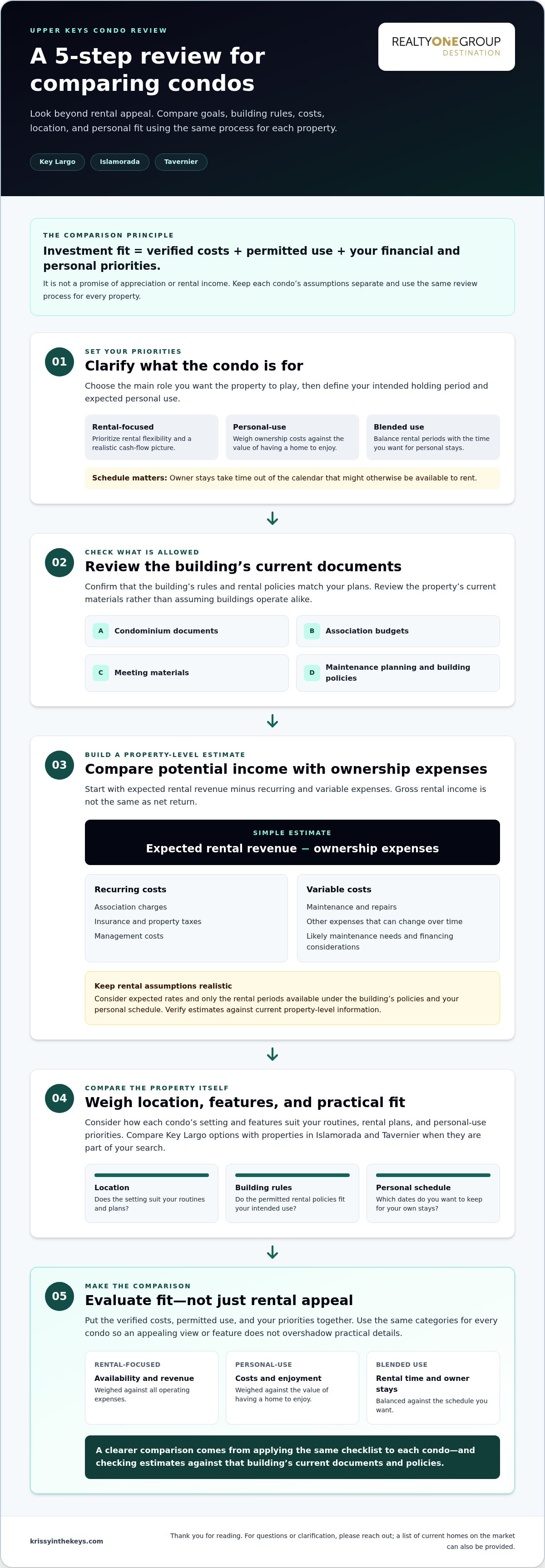
To decide whether a Key Largo condo is a good investment for your plans, compare each property using the same review process. A consistent checklist makes differences between buildings easier to see and helps keep an appealing view or feature from overshadowing practical details. Use the same process whether you’re considering Key Largo, Islamorada, Tavernier, or another Upper Keys location.
- Clarify your goals. Decide whether rental income, personal use, or a blend matters most, and identify your intended holding period.
- Review building documents. Read current condominium documents, association budgets, meeting materials, maintenance planning, and building policies.
- Assess ownership costs. Compare association fees, insurance, taxes, likely maintenance needs, and financing considerations for each property.
- Compare location. Consider how each condo’s setting and features suit your routines, rental plans, and personal-use priorities.
- Evaluate fit. Weigh the documents, costs, location, and purchase terms together before deciding whether the property works for you.
What should buyers review in condo documents?
Pay close attention to current rental policies. Check any restrictions, minimum-stay requirements, and approval processes in the applicable documents for that specific building. Don’t rely on assumptions based on another condo nearby. A condo’s rental rules must fit the buyer’s intended use. Also consider the association’s budget and meeting materials alongside information about building condition, planned maintenance, and insurance. These details help you understand the obligations and rules that apply to the unit you’re considering.
How can you compare active Key Largo condo listings?
Use your checklist across every candidate. For example, if personal stays are a priority, compare how each building’s policies accommodate your plans. If renting matters, assess the permitted rental use alongside projected costs. Keep financing and property condition in view, too. This like-for-like review can help you narrow the options without assuming that similar-looking condos have similar terms. A buyer representative familiar with Key Largo and the Upper Keys can help you organize the comparison around your criteria.
Explore current Key Largo-area property listings
Make a confident Key Largo condo decision with local guidance
A condo is worth moving forward with when its building policies, verified ownership costs, and permitted use align with what you want from the property. If the rental rules conflict with your plans, or updated expenses and documents change the financial picture, pause and reconsider. The right choice isn’t about forcing a property to fit. It’s about finding one that fits your priorities.
When should a buyer keep looking?
Keep looking if you expect to rent the condo but its policies don’t support your intended rental approach, or if restrictions limit the personal use you value. Revisit your assumptions if current documents reveal different costs, maintenance needs, or building conditions than you initially expected. A careful reassessment can help you avoid committing to a property that no longer matches your goals.
What should your next step be?
Start with a clear conversation about how you plan to use the condo, your financial priorities, and the trade-offs you’re comfortable making. Krissy Carnahan represents buyers of luxury condos and vacation properties across the Upper Keys, including Key Largo, Islamorada, and Tavernier. Her nearly 20 years of experience in Florida Keys real estate and management can help you compare buildings, locations, and current options against your criteria, without promising a particular investment result.
Asking “is a Key Largo condo a good investment” is most useful when you can assess actual properties against your own plans. Review current options with those priorities in mind, then narrow your search to condos whose policies and costs make sense for you.
Explore current Key Largo-area property listings
Take your next step toward the right Key Largo condo
So, is a Key Largo condo a good investment? It may be a strong fit when the building’s rental policies, verified ownership costs, and your intended use line up. Compare each property on those practical details, then weigh potential rental income against the value you place on having a place of your own in the Keys. A condo that suits someone else’s goals may not suit yours.
Krissy Carnahan is a licensed Florida Realtor specializing in Upper Keys luxury and vacation properties. With nearly 20 years active in Florida Keys real estate and management, and as a 5-star-reviewed trusted real estate advisor, she can help you compare current condos with your priorities in mind, without promising a particular return.
Thank you for considering Krissy as a resource for your search. Please get in touch with any questions or requests for clarification, or to receive a list of current homes on the market in Key Largo, Islamorada, Tavernier, and the Upper Keys.
Frequently Asked Questions
Is a Key Largo condo a good investment?
A Key Largo condo can suit some buyers, but no location guarantees returns. The answer to “is a Key Largo condo a good investment” depends on your goals, the building’s rental policies, verified expenses, property condition, and intended personal use. Evaluate the specific unit and its current documents rather than relying on broad market assumptions. That property-level review gives you a more grounded basis for deciding.
Can you rent out a condo in Key Largo?
You may be able to rent a Key Largo condo, but permissions and conditions vary by building and property. Before making a purchase decision based on rental income, review the current condominium documents and policies for that specific unit. Check how the rules align with your intended rental plan, and don’t assume another condo’s permissions or rental experience will apply.
What costs should I consider when buying a Key Largo condo as an investment?
Consider association fees, property taxes, insurance, maintenance, repairs, management, and financing assumptions. These costs affect what may remain after rental income is applied, so use property-specific information rather than general averages. Review the figures and building details for the unit you’re considering, and revisit your estimate if current documents or the property’s condition change your assumptions.
Is it better to buy a Key Largo condo for rental income or personal use?
Neither approach is automatically better; the right choice depends on your priorities. Rental-focused ownership calls for building policies and realistic operating assumptions that support your plan. Personal use brings lifestyle value, but your stays can reduce the time available for rentals. Compare both scenarios using your intended schedule, the unit’s rental conditions, and verified expenses to see which trade-off feels right.
How do I compare Key Largo condos before investing?
Compare intended use, current building policies and association documents, verified recurring expenses, property condition, and location. Apply the same checklist to each condo, and look beyond gross rental estimates. Krissy Carnahan represents buyers across Key Largo, Islamorada, Tavernier, and the Upper Keys, and can help organize the review around your criteria. Please get in touch with questions or requests for clarification, or to receive a list of current homes on the market.


