
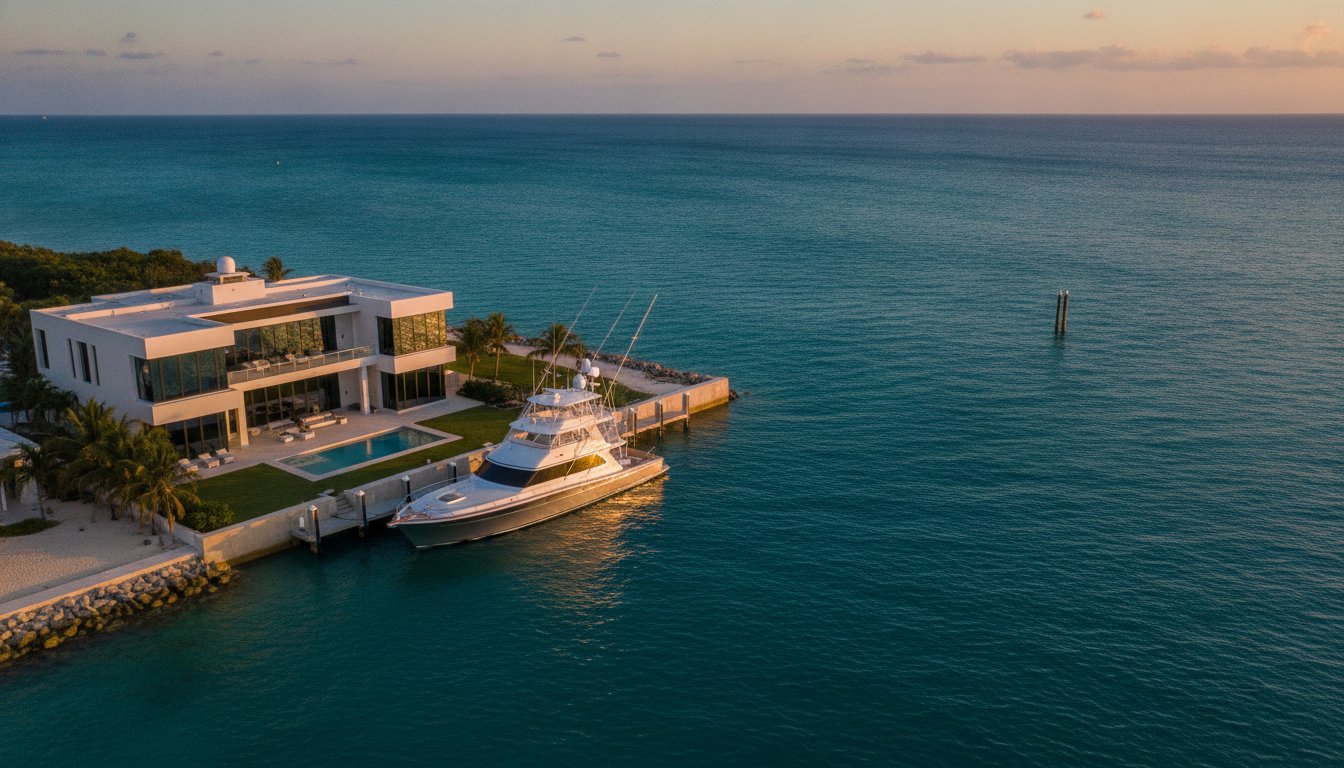
What if the six feet of water at your private dock doesn't actually mean you can get your sportfisher out to the reef? It is a frustrating reality for many boaters who rely on standard listing sites only to find that "deep water" is a relative term. When searching for Islamorada deep water access homes, the depth under your hull at the seawall is only half the story. You are likely worried about the "skinny water" of the Florida Bay or the complex web of local regulations that seem to change with the tide. We understand that finding a home for your vessel is a high-stakes investment, especially with the median waterfront listing price sitting at $1.92 million in mid-2026.
You deserve a transition into the Keys lifestyle that is as smooth as a calm morning on the Atlantic. This guide will help you master the technicalities of deep water dockage and specific navigation routes to find the perfect estate. We will explore the vital difference between dock depth and controlling depth, identify the best neighborhoods for large center consoles, and provide a clear roadmap for your technical due diligence. By the end, you'll have the confidence to navigate the local market like a seasoned captain.
Key Takeaways
- Understand the critical difference between depth at the slip and the channel's controlling depth to avoid the danger of "skinny water."
- Identify whether an Oceanside or Bayside route best suits your lifestyle, from immediate reef access to serene backcountry views.
- Learn how to evaluate dockage infrastructure, including the latest 2026 material trends and the lift tonnage required for modern luxury vessels.
- Gain clarity on the strict environmental regulations and permitting processes that dictate shoreline development in the Florida Keys.
- Discover how to use targeted search tools to find Islamorada deep water access homes that offer more than just a scenic view.
What Defines "Deep Water Access" in Islamorada?
In the Upper Keys, the label "deep water" is often thrown around by those who don't understand the draft of a fully loaded sportfisher. For a captain maneuvering a 50-foot Viking or a quad-engine center console, a loose definition simply won't suffice. Are you willing to risk your props on a guess? In 2026, the market for Islamorada deep water access homes has become increasingly strategy-driven. Serious buyers are prioritizing technical specifications that guarantee their vessel won't be grounded during a lunar low tide or a seasonal shift. With the median waterfront listing price hovering around $1.92 million, the stakes are too high to ignore the technicalities of your approach.
Controlling Depth vs. Dock Depth
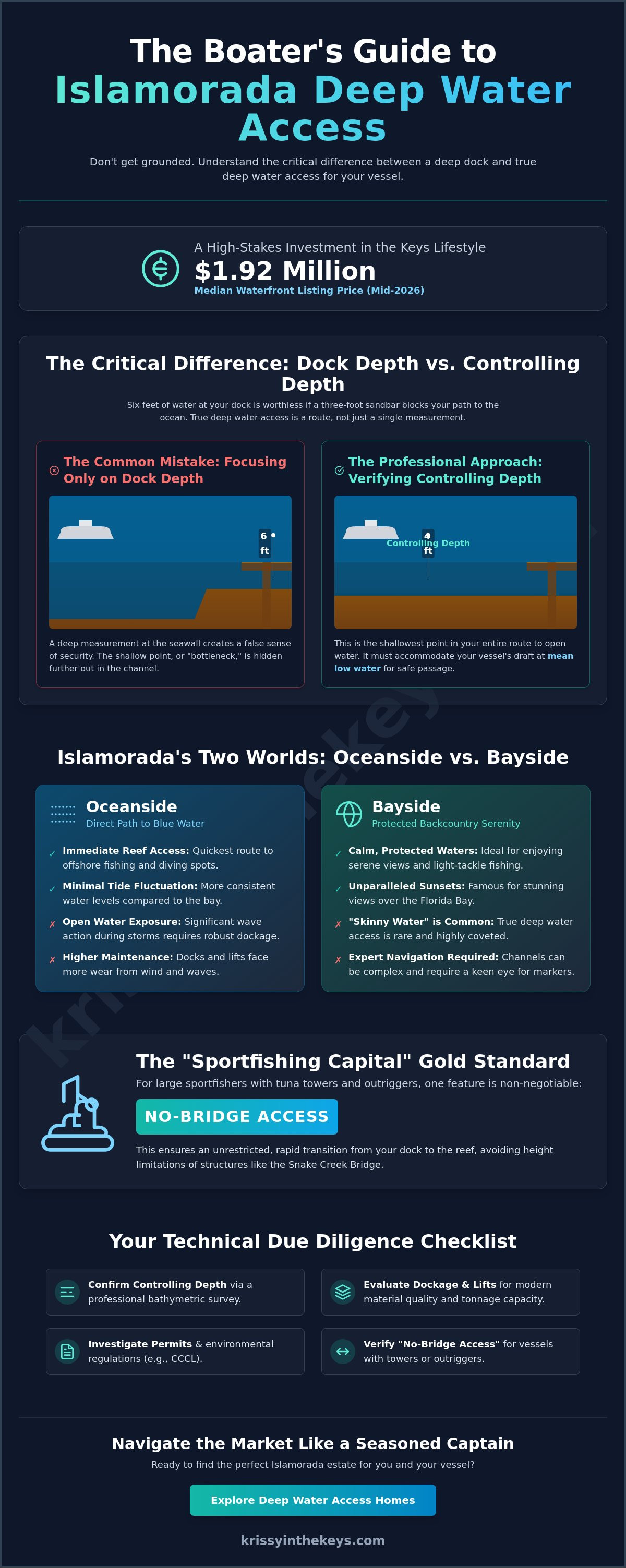
True deep water is a navigation route, not just a measurement at the dock. Many buyers make the mistake of measuring the water depth only at the seawall. While having six feet of water at your dock is excellent, it's irrelevant if the channel leading to the ocean is only three feet deep at low tide. This is the critical distinction between dock depth and controlling depth. Controlling depth is the shallowest point between your dock and open water, acting as the ultimate bottleneck that dictates your vessel size. When we evaluate potential estates, we look far beyond the property line. A professional property survey in 2026 should include a bathymetric look at the entire approach. We also account for moon phases and seasonal king tides, which can cause water levels to fluctuate by a foot or more. If your vessel requires a 4-foot draft, that measurement must be maintained at mean low water throughout the entire navigation route to ensure safe passage.
The "Sportfishing Capital" Standard
Does your dream lifestyle involve chasing sailfish at a moment's notice? Known globally as the Islamorada, Village of Islands, our community sits in a geographically complex position that requires local insight to navigate. Unlike Key Largo, where deep water is more readily available, Islamorada’s geography makes true deep-water access a rare and valuable commodity. This scarcity is why "no-bridge" access is the gold standard here. If you own a vessel with a tuna tower or outriggers, you can't afford to be restricted by the clearance of the Snake Creek Bridge or other local overpasses. We focus on identifying neighborhoods where large sportfishers can transition from the dock to the reef in minutes. You can start your hunt by exploring our current inventory of waterfront listings to see how different locations handle these specific draft and height requirements.
Islamorada’s Navigation Routes: Bayside, Oceanside, and Canals
Where you dock is just as vital as how deep the water is. In Islamorada, your lifestyle is dictated by which side of the island you call home. Are you an offshore angler chasing mahi in the Gulf Stream, or do you prefer the serene, glass-like waters of the backcountry? Choosing between Islamorada deep water access homes on the Atlantic or the Florida Bay involves more than just a preference for sunrises or sunsets. Each route presents unique navigational challenges and rewards. Understanding the Florida Keys boating regulations is essential as you move between these distinct marine environments, especially when crossing through protected sanctuary waters.
Oceanside Advantage: Direct Deep Water
Properties on the Oceanside offer the most straightforward path to blue water. If your vessel stays in the water year-round, these neighborhoods provide minimal tide fluctuation and immediate access to the reef. However, open-water exposure comes with a trade-off. Wave action can be significant during a blow, requiring heavier-duty boat lifts and more frequent dock maintenance. We often look for homes with "riparian rights," which allow for longer docks that can reach deeper water without the need for constant dredging. This direct access is a primary driver for the surge in eight-figure sales we've seen in early 2026.
Bayside and Backcountry Navigation
The Florida Bay is famous for its "skinny water," making "Deep Water Bayside" properties some of the most coveted and limited real estate in the Upper Keys. These estates often sit near deep basins or the Intracoastal Waterway (ICW), providing a rare combination of deep-water dockage and the calm, protected waters of the bay. Navigating these routes requires a keen eye for the markers. While the backcountry is a paradise for light-tackle fishing, reaching these deep-water pockets often means following specific, narrow channels that don't allow for much error. If you value privacy and mirror-still water, the Bayside is your sanctuary.
Bridge Clearances and Canal Widths
Snake Creek and Whale Harbor are the primary arteries for cross-island travel. If your boat has a high profile, the 27-foot clearance at the Snake Creek Bridge is your most important metric. For owners of large yachts or sailboats, "No Bridge" neighborhoods are the only viable option. Beyond vertical clearance, you must consider canal width. A narrow canal might have the depth you need, but it can make turning a 45-foot center console a stressful ordeal. Wider canals offer a better turning radius and increased privacy from neighbors across the water. You can filter for these specific navigational needs by using our advanced property search tool to find estates that match your vessel's dimensions.
Evaluating Dockage Infrastructure for Luxury Vessels
Is your dock built to handle the next generation of sportfishers? In the market for Islamorada deep water access homes, the quality of the seawall and dockage infrastructure often dictates the final sales price. A simple wooden pier might have sufficed a decade ago, but today's luxury vessels require sophisticated engineering. High-stakes buyers in 2026 are looking for concrete or high-end composite materials like Trex, which hold the most value due to their resistance to the punishing Florida sun and salt spray. Beyond the surface, you must inspect the dolphin pilings and fender systems. These are your first line of defense against surge and wind, ensuring your multi-million dollar investment remains pristine while moored. Does the property offer a wide enough turning radius to accommodate your vessel's beam? Remember that local standards dictate a dock cannot exceed ten percent of a water body's width, so every inch of design matters.
Advanced Boat Lift Systems
Hydraulic lifts are no longer a luxury; they're an expectation in the premium Islamorada market. As center consoles grow to 45 feet and beyond, matching lift tonnage to your boat's wet weight is a non-negotiable step in your due diligence. A quad-engine vessel can easily exceed 25,000 pounds when fully fueled. We recommend verifying that existing lifts are rated for modern hulls rather than older, lighter models. For those considering options further north, you can compare these standards in our guide on Waterfront Homes with Boat Lifts in Key Largo to see how infrastructure varies across the Upper Keys. High-speed lifts are particularly prized in 2026 for their ability to get you on the water in minutes.
Shore Power and Dockside Amenities
Modern yachts have heavy electrical demands that standard residential wiring can't always meet. While 30 or 50-amp service used to be the norm, 100-amp shore power is rapidly becoming the new standard for luxury estates. This ensures you can run multiple HVAC units and onboard systems without strain. Beyond power, consider the functionality of the dock's layout. Integrated fish cleaning stations, fresh water wash-downs, and underwater lighting aren't just perks; they're essential for the "Sportfishing Capital" lifestyle. If you're planning a dock expansion, be aware that dredging for boat slips is strictly limited to 100 cubic yards. We can help you identify properties where the existing footprint already meets your needs, saving you the complexity of the 2026 permitting process.
Navigating Regulations: Permits, Tides, and the CCCL
Is the notorious "red tape" of the Florida Keys a dealbreaker for your next estate? It shouldn't be. In 2026, the regulatory landscape for Islamorada deep water access homes is designed to protect the very environment that makes this the Sportfishing Capital of the World. While the permitting process is rigorous, it serves as a safeguard for your property value and the local ecosystem. You'll encounter oversight from the Village of Islamorada, the Florida Department of Environmental Protection (FDEP), and the Army Corps of Engineers. For instance, a residential building permit application fee for a new single-family residence is currently $1,863, and canal maintenance dredging carries a flat fee of $621. Understanding these costs and the jurisdictional boundary of the Coastal Construction Control Line (CCCL) is the first step in a successful technical due diligence process.
Waterfront Property Regulations for 2026
The 2026 building codes in Monroe County emphasize environmental preservation more than ever. Before you even think about modifying a dock, a benthic survey by a qualified marine biologist is essential to map seagrass and coral resources. If your project impacts these areas, you'll need a comprehensive mitigation plan to move forward. You can find a deeper dive into these requirements in our guide on Florida Keys Waterfront Property Regulations. Remember that your dock cannot exceed ten percent of the width of the water body, and your moored vessel must leave at least 75 percent of the navigable channel open for others. These rules ensure that our canals remain functional for everyone.
Tidal Trends and Sea Level Considerations
Moon phases and seasonal "King Tides" are no longer just conversation starters; they're critical factors in modern seawall design. We're seeing a significant shift toward "living seawalls" and advanced rip-rap solutions that provide better storm surge protection and habitat for local marine life. 2026 buyers are prioritizing "elevated dockage" to mitigate tidal shifts and protect their vessels from the extreme high-water events that can occur in the fall. If you're planning to build a boat ramp, keep in mind that dredging is limited to 100 cubic yards and must avoid submerged grass beds entirely. If you're ready to see how these regulations impact specific parcels, view our current inventory of Islamorada estates to find a property that has already cleared the major regulatory hurdles.
Finding Your Perfect Islamorada Deep Water Estate
Success in the Upper Keys real estate market isn't just about finding a beautiful home; it's about finding a home that welcomes your boat. Generic listing sites often fall short because they don't account for the specific draft of a neighborhood channel or the nuances of a local navigation route. When searching for Islamorada deep water access homes, your most valuable asset is local knowledge. We recommend performing a "sea trial" for the property itself before you reach the closing table. This involves navigating the actual route from the open ocean or bay to the private dock at mean low tide to ensure your vessel's draft and height are compatible with the journey. It's a level of technical due diligence that generic agents simply don't provide.
Matching the Vessel to the Venue
Every successful search begins with a "Boating Bio." This document should outline your vessel's draft, beam, tower height, and total length. Why does this matter? A neighborhood that is perfect for a deep-draft sailboat might be a nightmare for a sportfisher with a high tuna tower due to bridge clearances or narrow turning basins. In 2026, the market is strategy-driven, and buyers are more selective than ever. You can start narrowing down your options by using our Property Search Map to filter for estates that meet your specific dockage requirements. Whether you need the open-water proximity of Venetian Shores or the protected basins of Safety Harbor, having your vessel's specs ready ensures a precise match.
Expert Representation in the Upper Keys
Choosing a real estate partner who actually lives the Keys lifestyle is essential when evaluating Islamorada deep water access homes. As a 5-star reviewed trusted advisor, Krissy in the Keys (Krissy Carnahan, Realtor) provides more than just a tour of homes. We offer specialized marketing for sellers and advanced negotiating skills for buyers to navigate a market where premier properties stay on the market for an average of 146 days. If you're considering selling your current waterfront home to upgrade to a deeper slip, you can get a professional valuation to understand your equity in today's market. Our goal is to ensure your transition into the Islamorada boating community is seamless and successful. Are you ready to take the next step? Book a private tour of our premier boating communities today and let us help you find the estate where your vessel truly belongs.
Take the Helm of Your Islamorada Future
Securing a legacy on the water requires a strategic blend of technical precision and local intuition. You now understand that the true caliber of Islamorada deep water access homes is measured by the entire navigation route, from the controlling depths of the channel to the 100-amp service at your private dock. we've explored how 2026 regulations and advanced infrastructure work together to safeguard your vessel and your investment. When you're ready to transition from planning to the open water, you deserve a partner who navigates these complexities daily. Krissy in the Keys (Krissy Carnahan, Realtor) brings 20 years of local Florida Keys expertise and a proven track record as a 5-Star Reviewed Trusted Advisor. By combining specialized marketing for luxury waterfront estates with elite negotiating skills, we ensure your interests are protected at every turn. Start your Islamorada deep water home search with Krissy today! Your perfect slip is waiting; let's make it your reality.
Frequently Asked Questions
What is considered "deep water" for a boat dock in Islamorada?
Deep water generally refers to a draft of at least four feet at mean low tide, though the "gold standard" for Islamorada deep water access homes involves maintaining that depth throughout the entire navigation channel. It isn't just about the depth at your seawall. You must account for the controlling depth of the entire route to open water. This ensures that even during a lunar low tide, your sportfisher remains floating and ready for departure.
Can I dredge the channel behind my house if it is too shallow?
Maintenance dredging is strictly controlled by local and federal agencies and is limited to the minimum amount necessary. While you can apply for permits to clean out an existing boat slip, new dredging of submerged grass beds or hard bottom communities is prohibited. For canal maintenance dredging and cleaning in 2026, there's a flat fee of $621. Any excavation for boat slips is limited to 100 cubic yards and requires a benthic survey.
Do all waterfront homes in Islamorada have ocean access?
No, some waterfront properties are landlocked or have significant restrictions that prevent ocean access. Some homes sit on enclosed lagoons, while others are restricted by low bridges or shallow flats that only allow for kayaks or shallow-draft skiffs. It's vital to verify the specific navigation route before purchasing, as some "waterfront" views offer no viable path for a motorized vessel to reach the Atlantic or the Florida Bay.
What is the difference between a canal-front and an open-water home?
The primary difference is protection versus exposure. Canal-front homes offer a sheltered environment that protects your vessel from wind and wave action, which is essential for maintaining a high-end sportfisher. Open-water homes provide breathtaking, unobstructed views and immediate access to the sea but require heavy-duty boat lifts and fender systems to handle the surge. Most serious boaters prefer the calm of a wide canal for long-term dockage and easier maintenance.
Are there bridges in Islamorada that limit boat height?
Vertical clearance is a major factor in the Upper Keys, particularly at the Snake Creek Bridge. This bridge has a fixed clearance of 27 feet, which limits many large yachts, sailboats, and vessels with tuna towers. If your boat features a high profile, you should focus your search on "no-bridge" neighborhoods. This allows you to reach the reef or the backcountry without worrying about bridge schedules or height restrictions that could trap your vessel.
How do tides affect my ability to use a boat lift in the Keys?
Tides determine whether there is enough water for your lift's cradle to drop low enough to float your boat. If a lift is installed too high, an extreme low tide might leave your vessel stranded on the bunks. Conversely, seasonal "King Tides" can submerge dock electrical systems if they aren't properly elevated. We prioritize finding Islamorada deep water access homes where the dockage infrastructure is engineered to handle these specific 2026 tidal fluctuations safely.
What permits are required to install a new boat lift in 2026?
Installing a lift in 2026 requires a multi-agency approval process involving the Village of Islamorada and the FDEP. You'll need to submit a residential building permit application, which currently carries a fee of $1,863. This process includes a plan review and a benthic survey to protect seagrass and coral. Only one dock is permitted per single-family residence, and the structure must not obstruct more than 25 percent of the navigable portion of the water body.
Is homeowners insurance more expensive for deep water access homes?
Deep water access itself doesn't typically increase insurance premiums, but the property's overall value and flood zone do. Because deep-water homes are often premier estates, the replacement cost of the structure is naturally higher. The age and condition of your seawall are the most critical factors for your premium. Insurance providers look at the finished floor elevation and the seawall's integrity rather than the specific depth of the water in the canal.


