

For anyone navigating Monroe County building codes, the building safety inspection schedule is a key rule to understand: the first inspection is required when a building reaches 25 years of age, with recertifications every 10 years after the initial inspection. Monroe County sends certified-mail notices to owners of condominium buildings that are 25 years old or older and structures three stories or higher.
Planning a purchase, renovation, or land-use application raises an important first question: which Monroe County rules apply to the property? This guide explains how Monroe County, Florida, handles zoning, permits, land-use applications, and building safety inspections. Use it to prepare for property decisions and understand which county or city office to contact.
Key Takeaways
- Start by identifying which local jurisdiction governs the property, since zoning rules can differ inside and outside city limits.
- Learn how zoning, permits, appeals, variances, and land-use applications fit into the property planning process.
- Check planning and zoning office hours before arranging a call or visit, and prepare your property details and questions.
- Understand when building safety inspections begin and how often recertification is required, so you can plan ahead.
County zoning code administration and enforcement
For this guide, Monroe County means Monroe County, Florida. Start by identifying the parcel and the county office responsible for its zoning or building question, then review the documents that apply to that property.
Unified Development Code and Building Documents
A Unified Development Code brings land-use standards and review procedures together. For a proposed project, read the sections and forms covering the intended use, site plans, and application requirements. Gather the property address, project description, and relevant plans before contacting the responsible office. On 6/13/2023, the Florida Legislature recorded Chapter No. 2023-203, companion bill(s) passed, see CS/CS/CS/HB 799 (Ch. 2023-175).
Zoning and Property Standards
What are the local zoning, setback, height, and lot coverage rules in Monroe County? The parcel’s zoning designation and applicable county documents determine the standards for a proposed use or structure. Review the property-specific rules for building placement, height, and site coverage before finalizing plans. For a pre-lease or pre-purchase discussion, prepare the address and intended use so the inquiry focuses on that parcel.
Violation Penalties and Appeals
What are the penalties, deadlines, and appeal options for building code violations in Monroe County? Read the notice closely for the cited issue, required response, deadline, and appeal instructions. Keep the notice with approved plans, inspection records, and related correspondence. If you dispute a decision, follow the appeal process identified by the responsible authority and retain copies of your filing and any written outcome.
Identifying the County Code Department
Which Monroe County does the reader mean, and where is its official building information? This guide covers Monroe County, Florida. Use the Building Department section of the official Monroe County website for county building information. Before discussing a property, identify the parcel, proposed work, and whether your question concerns zoning, permits, or building documents. That helps identify the relevant county or city office.
Permits, appeals, variances, and land-use applications
For a property in Monroe County, Florida, first identify the parcel and the work or land-use change you’re considering. The correct application path depends on the property’s location and the nature of the request.
Permit Applications and Instructions
Follow the application instructions for the property’s jurisdiction and project type. Review the form before filing, note the required documents, and make sure the plans clearly describe the proposed work. If the authority offers online submission or an application tutorial, follow its steps and save a copy of your submission.
For a variance or appeal, identify the specific decision or standard at issue and follow the corresponding application process. Organize relevant plans, notices, and correspondence before filing. Keep copies of the submission and written responses so you can track review comments and understand the next step. A permit application does not replace a separate land-use request.
What are Monroe County building permit fees, and how are they calculated? The applicable fee schedule and permit category determine the charges. The proposed work and the review required for the application are relevant factors, so consult the schedule for the specific permit type.
Construction Permit Rules
What rules apply to electrical, plumbing, mechanical, and residential construction permits in Monroe County? Requirements depend on the property’s location and the work involved. Identify the parcel and describe the project to determine which permit application and construction standards apply.
Separate permit questions by trade and project scope. An application for electrical work, for example, may require different supporting details from one for residential alterations. Follow the relevant Monroe County instructions rather than assuming every project uses the same review process.
Before filing, compare the application requirements with your plans and supporting documents. If the project also needs land-use approval, a variance, or an appeal, keep that filing separate from the construction permit. This makes it easier to track each request, respond to review comments, and maintain a clear property record.
Planning and zoning office contact hours
For Monroe County, Florida, distinguish planning and zoning questions from building permit or inspection matters. Start with the property’s location and the question you need answered, then use the relevant department’s contact information to plan your call or visit.
Office hours affect when staff can respond, so consult the county’s current official contact information before arranging an in-person discussion. Monroe County, Iowa, and Monroe County, Indiana, serve different jurisdictions; their schedules and procedures do not establish Florida office hours.
Make your first contact more productive by preparing a few property-specific details:
- Write down the property address or parcel location.
- Describe the proposed use, purchase, or land-use change.
- Name the document or decision you’re asking about, such as a zoning application or permit notice.
- Separate planning questions from building inspection questions.
A buyer considering a property for a particular use, for instance, can ask which zoning materials apply and how to submit a land-use question. An owner with an inspection notice can refer to the notice and ask about the appropriate contact channel. Clear details help staff understand whether the inquiry concerns planning, zoning, permits, or building safety.
If you plan to visit, note the department name, office address, public hours, and any appointment instructions from Monroe County’s official listing. For a phone call, keep the parcel details and relevant application or notice nearby. If the first contact cannot address the issue, ask which county office handles that subject and record the department name and next step.
These preparations keep the discussion focused and help avoid confusing Florida procedures with another Monroe County’s schedule. Save the response with your property records, especially if it identifies a form, department, or follow-up step. If you’re planning a purchase or sale, align your inquiry with the next milestone, such as reviewing an application or evaluating the property.
Monroe County building safety inspection requirements
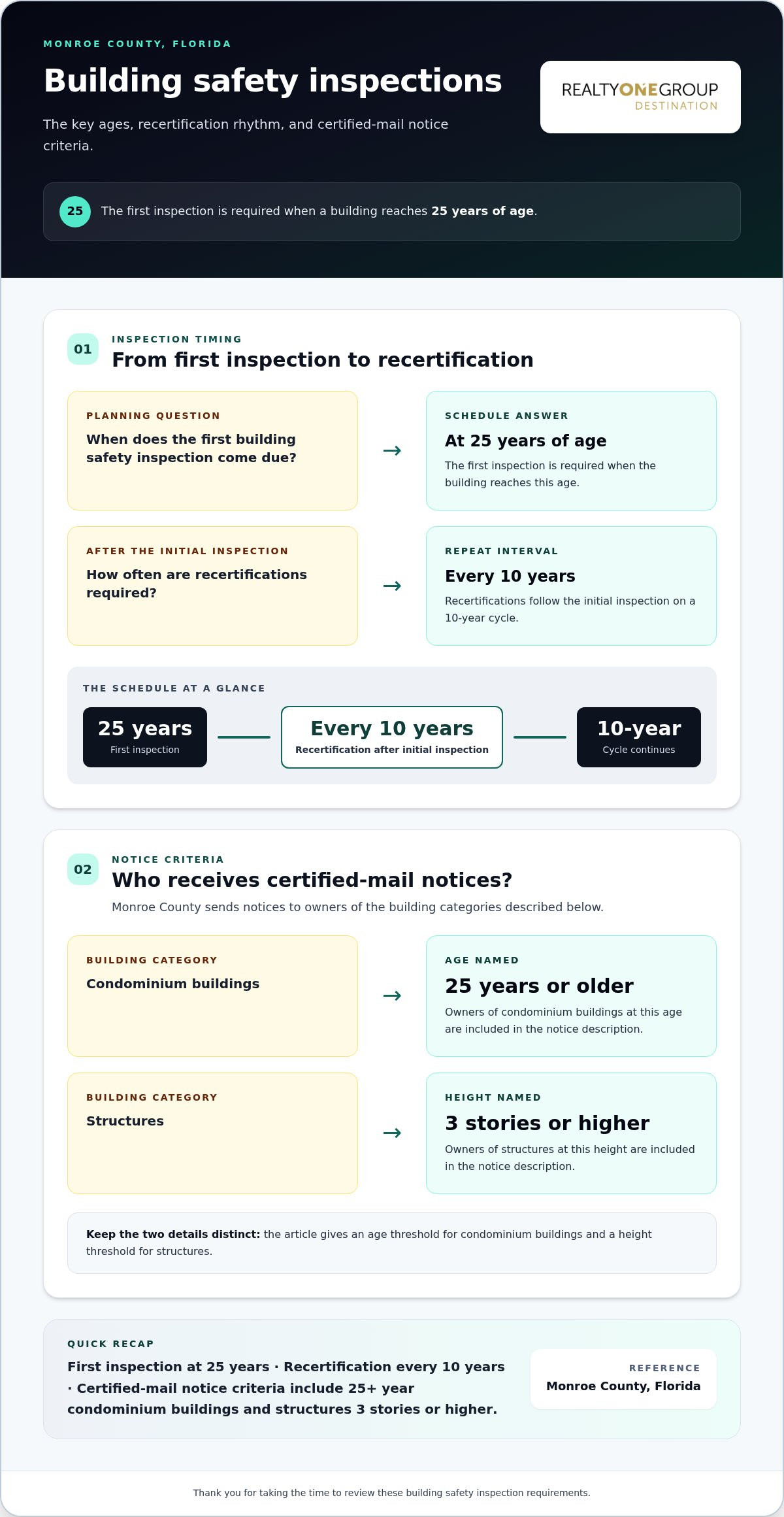
Monroe County’s building safety inspection schedule has a clear age-based trigger. The first building safety inspection is required when a building reaches 25 years of age. After that initial inspection, recertification is required every 10 years. These milestones help owners plan ahead and keep inspection notices and property records organized.
Monroe County sends certified-mail notices to owners of condominium buildings that are 25 years old or older and structures three stories or higher. Read the notice carefully: it identifies the property and the inspection process that applies. Keep the notice with prior inspection reports, building records, and any correspondence about the property.
The initial age threshold was previously 40 years before the requirement changed to 25 years. For owners familiar with the earlier threshold, that change makes it especially important to review the building’s age and any county notice rather than relying on an older timeline.
Owners may request a 180-day inspection extension by submitting a request form. Submitting the form doesn’t guarantee approval, so treat it as a request rather than an automatic change to the inspection schedule. Keep a copy of the submitted form and any decision with the building’s records.
Are there special Monroe County building requirements for flood zones, hurricanes, historic properties, or environmental protection? The building safety schedule described here is based on building age and height. Flood, hurricane, historic-property, and environmental reviews are separate considerations, so recertification timing does not replace them.
When buying or selling a condominium or a taller building, include inspection notices and recertification history in the records you review. A clear timeline helps you understand the property’s inspection stage and identify upcoming milestones. Keep the building age, notices, inspection reports, and extension decisions together in the property file.
Browse current property listings
Krissy in the Keys (Krissy Carnahan, Realtor): Luxury Waterfront Home Sales
Krissy in the Keys, led by Krissy Carnahan, helps buyers and sellers make informed real estate decisions in the Upper Florida Keys, including Islamorada, Key Largo, and Tavernier. For a luxury waterfront home or estate, Buyer Representation for Luxury Estates supports you through the purchase process, while Seller Representation of Luxury Estates helps owners prepare to bring a property to market. Vacation Property Sales also serve buyers and sellers focused on a getaway property.
Building safety notices and permit requirements are important records to consider alongside your property plans. Direct technical questions to the relevant county or city department, and turn to real estate representation for guidance on buying or selling the property.
For help with a property search or sale in Islamorada, Key Largo, or Tavernier, get in touch with Krissy in the Keys to discuss your goals and next steps.
Move Forward With a Clear Property Plan
Navigating Monroe County building codes is one part of a thoughtful property decision. Before buying or selling in Islamorada, Key Largo, or Tavernier, connect your plans with the questions that matter most.
As you continue navigating Monroe County building codes, keep your real estate goals distinct from technical code questions. Krissy in the Keys offers Luxury Waterfront Home Sales, Buyer Representation for Luxury Estates, and Seller Representation of Luxury Estates in the Upper Florida Keys, including Islamorada, Key Largo, and Tavernier. If you’re considering a luxury property purchase or preparing to sell an estate, contact Krissy Carnahan to discuss your priorities and the transaction.
To discuss buying or selling a property in Islamorada, Key Largo, or Tavernier, get in touch with Krissy in the Keys. Navigating Monroe County building codes alongside your property plans can help you approach your next real estate decision with greater clarity.
Thank you for reading. Your next property decision can begin with a conversation about what you’re looking for in the Upper Florida Keys.
Frequently Asked Questions
What building codes and editions are currently adopted in Monroe County?
The applicable code edition depends on the property’s jurisdiction, so “Monroe County” alone does not identify one edition for every project. First determine whether the parcel is in unincorporated Monroe County or within a city, then consult the building department’s code information for that location. North Carolina editions discussed elsewhere apply to the City of Monroe, North Carolina, not automatically to Florida Keys properties.
What types of projects require a building permit in Monroe County?
Permit requirements depend on the work, property location, and applicable local code. Before starting a project, describe its scope to the department responsible for the parcel and ask which permit category and application materials apply. A proposed alteration and a new structure, for example, may follow different review paths. Zoning approval alone does not cover building work, and one county’s permit rules do not govern another.
How do I apply for a building permit in Monroe County, and what documents are required?
Identify the correct jurisdiction and select the application for your project type. Read the form instructions for required plans and supporting materials, then submit them through the listed process. Keep a copy of the application and documents. For a property in the Upper Keys, including Islamorada, Key Largo, and Tavernier, use the authority responsible for that specific parcel rather than another Monroe County’s forms.
What inspections are required during construction, and how do I schedule them?
Inspection stages depend on the approved project and the jurisdiction’s permit instructions. Use the permit documents to identify required inspection points and scheduling steps, then arrange each inspection through the responsible department as the work reaches the relevant stage. Keep inspection results and correction notices with the project records. Building safety recertification for existing buildings is separate from construction-stage inspections.
How do Monroe County building code requirements differ between incorporated towns and unincorporated areas?
Zoning authority can differ by location: Monroe County zoning regulations apply to unincorporated areas outside cities’ corporate limits. A parcel inside a city may follow that city’s zoning administration, while county requirements may govern an unincorporated parcel. Before planning work in Islamorada, Key Largo, or Tavernier, identify the parcel’s jurisdiction and direct zoning and building questions to the corresponding office.
What rules apply to electrical, plumbing, mechanical, and residential construction permits in Monroe County?
Requirements depend on the property’s location and the type of work. Identify the parcel and project scope, then use the relevant permit application and construction standards. Separate trade work may require different supporting details.


