

Higher dues at a luxury condo may cover work that a detached-home owner pays for separately. Understanding Upper Keys luxury condo HOA fees starts with what the association maintains: shared spaces, building components, insurance, and long-term reserves can all shape the monthly cost.
If you’re comparing a condo with a home, it’s reasonable to ask why the dues differ and what they cover. Condo fees generally support shared building and community costs. Detached-home owners often maintain their own structures and land, even if they also pay dues for neighborhood amenities.
This comparison explains what condo fees may cover, how insurance and reserves affect budgets, and why condo dues can exceed detached-home HOA dues. You’ll also learn which records to review when assessing an association’s finances and comparing ongoing ownership costs in Key Largo, Islamorada, and Tavernier.
Key Takeaways
- Condo dues can cover shared building upkeep as well as amenities, so look beyond the monthly amount to understand what the fee supports.
- Staffing, insurance, and reserves all shape an association’s budget; the balance among them can affect both current dues and future costs.
- Review reserve planning and potential special assessments to better understand the financial commitments that may come with a property.
- Compare condos and detached homes by considering which maintenance responsibilities the association covers and which remain yours.
What Are Condo Fees?
Condo fees are recurring association dues that help pay for shared property costs. How do luxury condo fees compare in Key Largo and Islamorada? Fees vary by building, included services, and maintenance needs, so location alone doesn’t determine which area costs more. To have Upper Keys luxury condo HOA fees explained in context, start with what each association maintains.
Shared Building Maintenance
In a condominium, owners share responsibility for common areas and building components through the association. Fees may cover roofs, exterior surfaces, elevators, pools, and hallways, not just neighborhood amenities. For example, an elevator adds shared equipment to maintain that a detached home doesn’t have. Unit size or ownership percentage may help determine each owner’s share.
Neighborhood Services and HOA Dues
Detached-home HOA dues often focus on the neighborhood rather than each home’s structure. An association may maintain a shared pool, landscaping, sidewalks, or other common spaces, while owners generally handle their own home and lot. Some communities also include trash removal or administrative costs. The governing documents and budget show which services apply, helping buyers distinguish association dues from utilities billed directly to an owner.
Condo associations commonly carry a master insurance policy for shared building elements; owners often use an HO-6 policy for interior coverage. The division depends on what the association insures and what the unit owner’s policy covers. Condo fees may also contribute to a reserve fund for future repairs, so reserve funding is part of the association’s overall financial picture, not simply a current maintenance expense. Buyers who want Upper Keys luxury condo HOA fees explained clearly should consider the budget, insurance summary, and included services together.
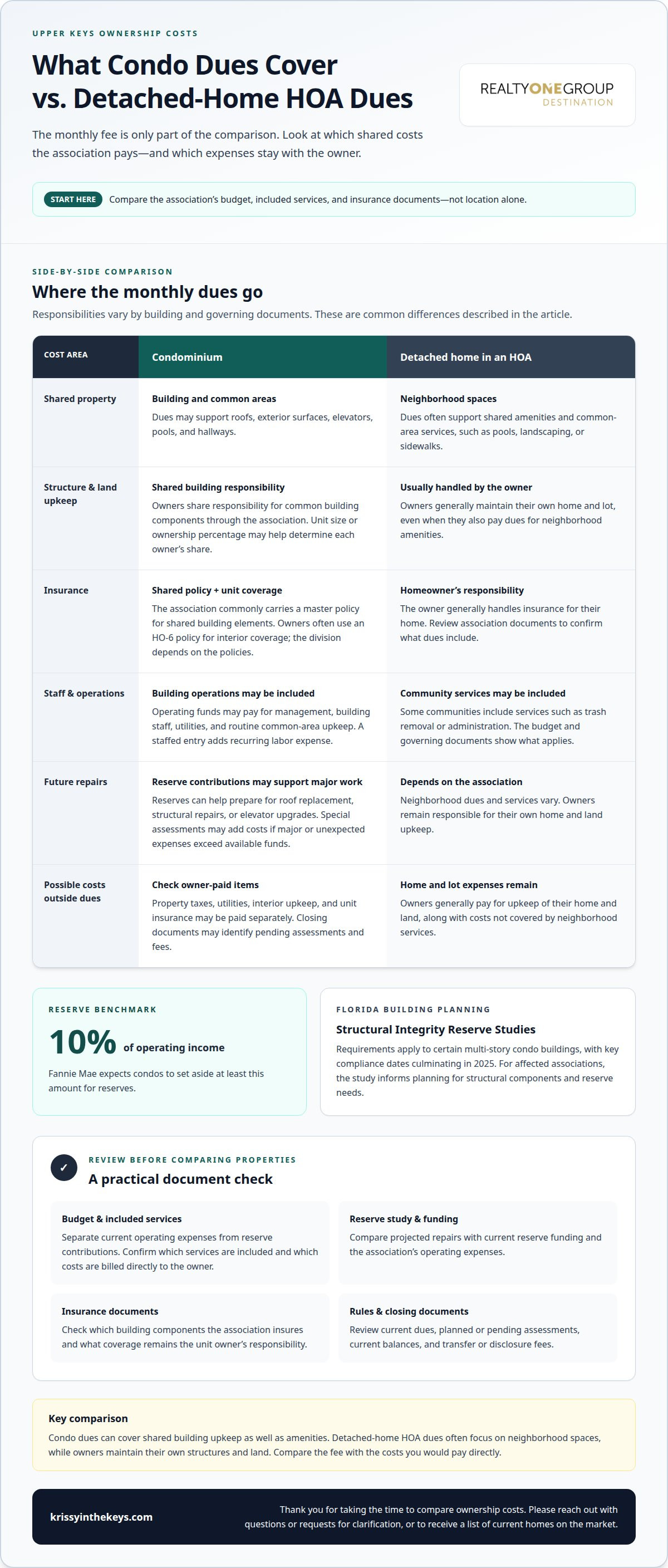
| Property type | Shared costs | Typical owner responsibility |
|---|---|---|
| Condominium | Building upkeep, common areas, and master policy | Unit interior coverage and costs assigned to the unit |
| Detached home in an HOA | Neighborhood amenities and common-area services | Home structure and land upkeep |
To compare properties, weigh what the association fee covers against the maintenance and insurance costs you would pay directly for a home.
HOA fee line items: staffing, reserves, and insurance
An association budget separates current operating expenses from money set aside for future work. Staffing, insurance, repairs, and amenities can each affect monthly dues.
Staffing and Operating Funds
Operating funds pay current bills, including management, building staff, utilities, and routine upkeep of common areas. A staffed entry, for example, adds a recurring labor expense that a self-managed building may not have. These costs support day-to-day services, while reserve contributions are intended for larger future repairs. Association documents show how expenses and responsibilities are assigned.
Reserves for Future Repairs
A reserve fund helps prepare for major work such as roof replacement, structural repairs, or elevator upgrades. Reserve funding is distinct from operating cash because it plans for significant future expenses rather than current bills. Fannie Mae expects condos to set aside at least 10% of operating income for reserves. A reserve study estimates upcoming needs and helps show whether funding aligns with the repair schedule.
Florida’s Structural Integrity Reserve Studies requirements apply to certain multi-story condo buildings, with key compliance dates culminating in 2025. For an affected association, the SIRS informs planning for structural components and reserve needs. It can influence how the budget allocates contributions, rather than serving as a general allowance for amenities or routine staffing.
Insurance is another operating expense that can affect dues. Premiums, coverage, and the association’s share of insured building components shape the budget; owners may also need separate coverage for their unit’s interior. Review the association’s budget and insurance documents together to see which costs are included in the monthly fee and which remain individual responsibilities.
For buyers, compare the reserve study’s projected repairs with the association’s current reserve funding and operating expenses. Reviewing these documents can clarify whether dues support both current services and planned building work.
Reserve funds, special assessments, and building compliance
What are typical monthly HOA fees for luxury condos in Key Largo and Islamorada? There isn’t one typical fee for either area. Building services, insurance, maintenance needs, and reserve funding all affect the monthly amount. Compare each association’s budget and planned work rather than relying on location alone.
What additional costs are not covered by condo HOA fees in the Upper Keys? Owners may pay separately for property taxes, utilities, interior upkeep, and insurance for their unit. A special assessment can also add costs beyond regular dues if the association faces major repairs or unexpected expenses.
Before buying, review the association’s rules, current dues, financial documents, and any planned assessments. Closing documents may show current balances, pending assessments, and transfer or disclosure fees. These details help clarify the ongoing cost of ownership, not just the advertised monthly fee.
A special assessment may fund major repairs or unexpected expenses that exceed the association’s current budget. For example, elevator or exterior work may cost more than operating funds can cover. That possibility makes the association’s repair plans and available reserves important parts of a buyer’s cost review.
Reserve planning also offers a way to assess whether savings align with anticipated work. Nolo identifies 70% to 100% of projected capital needs over 30 years as a reserve-study benchmark. Compare the study’s projected costs with the association’s funding and schedule. A gap can point to greater reliance on future dues increases or assessments.
To estimate monthly carrying costs, combine regular association dues with separate expenses such as taxes, utilities, and unit upkeep. Then account for planned assessments and repairs described in the association documents. This gives you a more complete basis for comparing properties in Key Largo and Islamorada, beyond the monthly dues alone.
Monthly dues depend on each building’s services, insurance, maintenance needs, and reserve funding. Luxury condos in Key Largo and Islamorada therefore don’t have a single representative rate.
Why condo fees exceed detached-home HOA dues
Condo dues often exceed detached-home HOA dues because the association manages more of the property. A condo budget may include building operations, maintenance, insurance, and funding for major repairs. In many single-family neighborhoods, the association maintains shared amenities while homeowners remain responsible for their homes and lots. The difference comes down to how much responsibility the governing documents assign to the association.
That division can affect the typical monthly cost. In some markets, condo fees can be 25% to 60% higher than single-family HOA fees. These figures aren’t Upper Keys estimates. They illustrate how the scope of association services and funding can influence dues.
A condo association coordinates costs across a building, from common-area operations to long-term maintenance planning. A detached-home association may instead fund landscaping, sidewalks, or a pool, while each owner arranges upkeep for their property. Some detached-home communities also include exterior maintenance, so the distinction depends on the services and responsibilities set out in the governing documents.
For buyers, having Upper Keys luxury condo HOA fees explained alongside detached-home dues makes the ownership trade-off clearer. First, identify the services each association funds. Then separate those costs from expenses you would pay directly, such as home maintenance or unit coverage. Finally, consider reserve funding and planned work. Lower dues may simply reflect fewer shared services, not a lower overall cost of ownership.
A useful comparison explains Upper Keys luxury condo HOA fees in terms of each association’s responsibilities, then weighs those against owner-paid expenses. Review the governing documents and budget together. This helps show whether dues cover building-wide services or a smaller set of neighborhood amenities, giving you a clearer basis for comparing properties across the Upper Keys.
Krissy in the Keys (Krissy Carnahan, Realtor): Luxury Condominium Sales
Krissy in the Keys (Krissy Carnahan, Realtor) represents luxury condominium buyers weighing association costs alongside location, lifestyle, and property features. If you’re comparing a condo with a detached home, her buyer representation can help you assess each option against your priorities and purchase plans.
Association dues are one part of ownership, alongside building services, reserve planning, and costs that remain separate. Krissy brings specialized marketing and negotiating skills to luxury real estate transactions and helps buyers consider their options with a clearer understanding of the choices ahead.
Thank you for reading. Please contact Krissy in the Keys with questions or requests for clarification, or to receive a list of current homes available on the market.
Choose the Property That Fits Your Next Chapter
Having Upper Keys luxury condo HOA fees explained gives you a clearer basis for weighing the ownership experience you want. Decide which property type, setting, and level of association responsibility best fit your plans. A conversation with Krissy, who knows the Upper Keys markets of Islamorada, Key Largo, and Tavernier, can help turn that comparison into a thoughtful real estate decision.
Krissy in the Keys (Krissy Carnahan, Realtor) represents buyers of luxury estates and waterfront homes, and supports sellers with marketing and negotiation. If you’re considering a purchase or preparing to sell in the Upper Keys, contact Krissy to discuss your goals and next steps.
Start with a conversation about your plans for the Florida Keys.
Frequently Asked Questions
Do you have to join an HOA?
For a home in a mandatory association, membership generally comes with ownership rather than personal choice. The obligation is tied to the property and may be established through its purchase documents. Before buying in Key Largo, Islamorada, or Tavernier, confirm whether the property belongs to an association and review the governing documents to understand the responsibilities and payment terms that transfer with ownership.
What is included in Upper Keys condo HOA fees?
Coverage depends on the building’s budget and association documents. A fee may include building insurance, exterior maintenance, pools, landscaping, cable, internet, water, or marina facilities. For example, two waterfront condos in Islamorada may offer different shared services. Check the budget’s line items to see which services are included, billed separately, or handled by the unit owner.
How do HOA fees vary by condo size, amenities, and waterfront location?
Condo size can affect an owner’s allocated share when fees are based on unit area or ownership percentage. Amenities matter, too: a building with a pool, staffed entry, or marina facilities has different operating needs from one without them. Waterfront location alone doesn’t determine the fee. In Key Largo or Tavernier, compare the association’s actual services and fee-allocation method.
How do Florida condo reserve requirements and structural inspections affect HOA fees?
For certain multi-story Florida condo buildings, Structural Integrity Reserve Studies inform planning for major structural components. Key compliance dates for these requirements culminated in 2025. Study findings can shape how the association plans funding for future work, which may affect dues or assessments. For a specific condo, review the study and related budget documents to understand the building’s identified needs and funding approach.
Are there recent special assessments for Upper Keys condo owners?
There isn’t one assessment that applies across all Upper Keys condos. Special assessments depend on an individual association’s expenses and decisions, so a past charge at one Islamorada property doesn’t establish that another property will have one. For a property you’re considering, review the transaction documents for pending assessments, outstanding balances, and information about planned work.
What documents should buyers review to evaluate a Florida condo association's finances and fees?
Start with the current budget, financial statements, reserve study, insurance information, and governing documents. Then review meeting materials for discussion of repairs, funding, or proposed assessments. Transaction documents may identify current dues, balances, pending assessments, and transfer or disclosure fees. In Key Largo, Islamorada, or Tavernier, reading these records together helps explain how the association’s finances relate to the specific unit.
Thank you for reading. Please contact Krissy in the Keys (Krissy Carnahan, Realtor) with any questions or requests for clarification, or to receive a list of current homes available on the market.


