

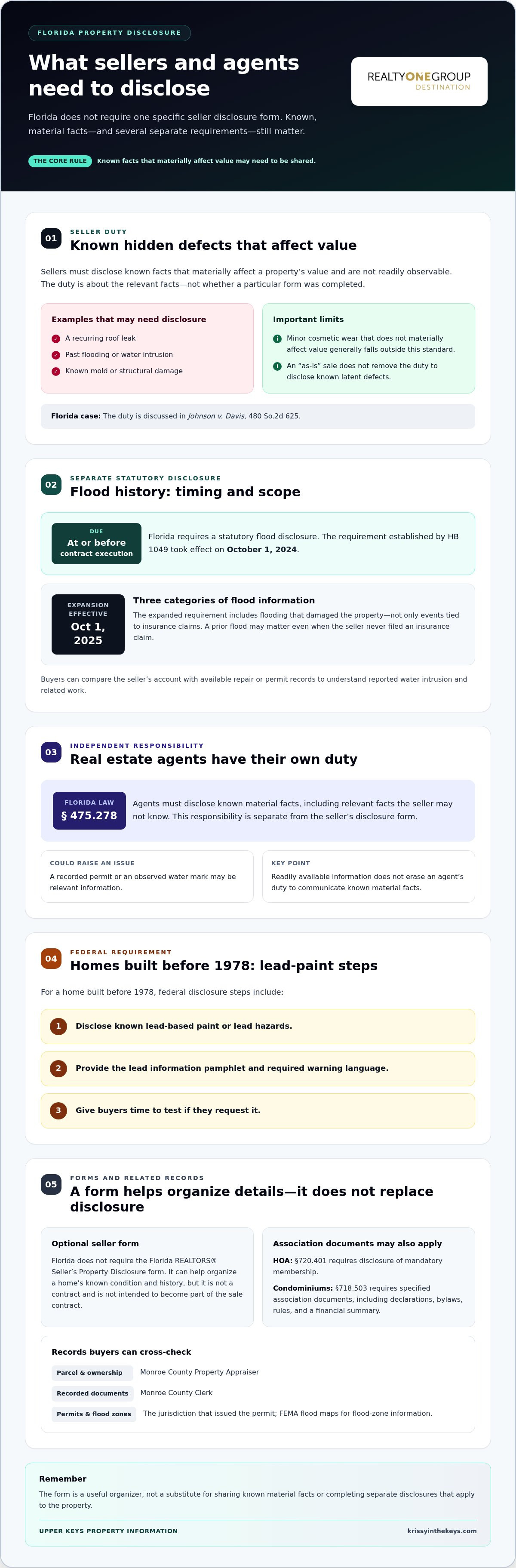
Florida doesn’t require sellers to use a specific property disclosure form, but they must disclose known, hidden defects that materially affect a property’s value. An Upper Keys luxury property disclosure statement can help organize key details, while separate disclosures, including the required flood disclosure, may also apply.
That distinction matters when a home’s history, condition, or ownership arrangements raise questions. Sellers must share relevant facts they know, and real estate agents have a separate duty to disclose known material facts. This article explains Florida’s requirements, what a disclosure form does and doesn’t do, and how seller and agent responsibilities differ, helping you understand what must be shared in a luxury property transaction.
Key Takeaways
- Florida doesn’t require sellers to use a specific property disclosure form, but known material defects that aren’t readily observable still matter.
- Flood history has its own required disclosure, so understand what sellers must share and when the disclosure is due.
- For homes built before 1978, federal lead-paint disclosure steps include sharing known hazards and giving buyers time to test if requested.
- Real estate agents also have disclosure duties, including sharing known material facts that could affect a buyer’s decision.
Does Florida require a seller disclosure form?
No. Florida law doesn’t require sellers to complete the Florida REALTORS® Seller’s Property Disclosure form. But sellers still have a duty to disclose known, hidden facts that materially affect a property’s value. In Johnson v. Davis, 480 So.2d 625, the Florida Supreme Court addressed that duty. The responsibility concerns relevant property facts, not simply whether a particular form was used.
The Florida REALTORS® Residential Seller’s Property Disclosure is an optional form that helps sellers organize information about a home’s condition and history. An Upper Keys luxury property disclosure statement can give buyers a clearer account of details relevant to a high-value home. The form states that it isn’t a contract and isn’t intended to become part of the sale contract. Florida REALTORS® strongly encourage sellers to use it when listing. Its questions can guide a seller’s review, but they aren’t a complete checklist of every fact that may matter.
Known material defects that buyers can’t readily observe may need to be disclosed. Examples include a recurring roof leak, past flooding, mold, or structural damage known to the seller. Minor cosmetic wear that doesn’t materially affect value generally falls outside this standard. An as-is sale doesn’t remove the duty to disclose known latent defects. If a buyer discovers an issue during an inspection before closing, that discovery may affect whether the issue remains undisclosed.
What permits and code-compliance records should Upper Keys sellers disclose? Florida’s general disclosure duty covers known facts that materially affect a property’s value. Permit and inspection records can help explain known work or compliance issues, especially when the details aren’t readily observable.
Are there condominium, homeowners association, or resort-community disclosure requirements in the Upper Keys? Yes, requirements can apply by property type. Florida Statutes §720.401 requires disclosure of mandatory homeowners’ association membership, while §718.503 requires condominium sellers to provide specified association documents, including declarations, bylaws, rules, and a financial summary. An Upper Keys luxury property disclosure statement should be considered alongside any applicable association documents.
Do Florida real estate agents have disclosure obligations?
Flood disclosures give buyers information about a property’s flood history and clarify what sellers must share before contract execution. Agents also have a duty to disclose known material facts, including relevant information the seller may not know.
Flood History and Risk
Florida’s statutory flood disclosure sets out information sellers must provide about a property’s flooding history. The requirement established by HB 1049 took effect October 1, 2024, and the disclosure is due at or before contract execution. Effective October 1, 2025, the requirement covers three categories of flood information. The expansion includes flooding that damaged the property, not only events tied to insurance claims. Buyers can use this history to frame questions about prior events and property records.
Water Damage and Drainage
Flooding, water intrusion, and drainage problems can cause damage that isn’t readily visible during a showing. A prior flood may matter even if the seller never filed an insurance claim. Sellers should disclose known flooding that damaged the property under the expanded disclosure requirements. For example, buyers reviewing a home with past water intrusion can compare the seller’s account with available repair or permit records. This context helps distinguish a disclosed event from a condition that may still affect the home.
Are there special disclosures for waterfront, canal-front, or oceanfront homes in the Upper Keys? Florida’s flood disclosure requirements apply to relevant property transactions, and the 2025 expansion includes damaging floods beyond insurance claims. Waterfront setting makes a clear account of known flood history especially useful to buyers.
Where can buyers find Monroe County and Florida property records, permits, and flood-zone information? Check parcel and ownership details through the Monroe County Property Appraiser, recorded documents through the Monroe County Clerk, and local permitting records through the jurisdiction that issued the permit. FEMA flood maps show flood-zone information; compare the map with the property address and available records.
For agents, Florida Statutes § 475.278 requires disclosure of known material facts, including facts the seller may not know. An agent’s duty to disclose is separate from the seller’s form. A recorded permit or an observed water mark may raise a relevant issue; readily available information does not erase the duty to communicate known facts.
What Is a Property Disclosure Statement?
A property disclosure statement records a seller’s known information about a home’s condition and history. In Florida, a form helps communicate details, but it doesn’t replace disclosure duties.
Known Defects Buyers Cannot Easily See
A known material defect affects value but isn’t readily observable to a buyer. Florida’s standard, discussed in Johnson v. Davis, 480 So.2d 625, covers known hidden facts that affect value. A roof leak concealed by a ceiling finish, for example, may warrant disclosure if the seller knows about it. Buyers need those details because a showing may not reveal concealed damage.
Environmental Hazards and Defective Drywall
Known environmental hazards or defective drywall may require disclosure when they materially affect the property’s value. Florida law also requires disclosure of the possible existence and dangers of radon gas under §404.056. A seller who knows about drywall damage or previous remediation should describe the known condition. That account helps buyers distinguish a repaired issue from an unresolved one.
For homes built before 1978, sellers must disclose known lead-based paint or lead hazards, provide a lead information pamphlet, include required warning language in the contract, and give buyers time to test for lead if requested, according to the U.S. Environmental Protection Agency. These federal steps apply alongside Florida disclosure duties.
An as-is sale doesn’t eliminate a Florida seller’s duty to disclose known latent defects. If the seller knows about hidden structural damage or an ongoing leak, as-is wording doesn’t erase that knowledge. A buyer’s inspection investigates the property’s condition; disclosure communicates what the seller already knows. Buyers can consider both the disclosure and inspection findings when evaluating the property.
The Florida residential seller disclosure form isn’t a contract and isn’t intended to become part of the sale contract. Its checkboxes don’t replace disclosure of relevant known facts that fall outside the form.
Real estate agent disclosure obligations
Florida real estate agents have disclosure duties that stand apart from a seller’s responsibilities. Under Florida Statutes §475.278, brokers and agents must disclose known material facts, including facts the seller may not know. The standard focuses on facts that affect the property’s value and aren’t readily observable. An agent who notices an unreported structural concern, for example, can’t treat the seller’s form as the only relevant information.
This duty matters because an agent may learn details through conversations, records, or property visits. If a buyer asks about a visible ceiling stain, the agent should share known information rather than offer unsupported reassurance. The same principle applies when a document reveals an unresolved issue. Buyers benefit from clear facts they can weigh alongside inspection findings and contract terms.
Sellers must disclose known material facts, while agents must disclose material facts they know, even if the seller doesn’t. These duties overlap, but neither replaces the other. A completed seller disclosure form doesn’t excuse an agent from communicating a separate known issue. Likewise, an agent’s disclosure doesn’t remove the seller’s responsibility to provide accurate information.
Florida law also identifies certain matters that aren’t treated as material facts for disclosure. Under §689.25, a property’s history as the site of a homicide, suicide, or death isn’t a material fact that must be disclosed in a real estate transaction. By contrast, §689.261 requires a contract disclosure that property taxes may increase substantially after purchase. For condominiums, §718.503 addresses mandatory association membership and specified association documents.
For buyers, a useful step is to ask which known facts came from the seller, which the agent observed, and which appear in a document. Connect answers to the relevant property record or contract disclosure. This helps buyers understand where information came from and identify questions about condition, taxes, or association obligations before signing.
Explore current Upper Keys property listings
Krissy in the Keys (Krissy Carnahan, Realtor): Luxury Waterfront Home Sales
Krissy in the Keys (Krissy Carnahan, Realtor) guides sellers and buyers through luxury waterfront transactions. Turn to her for Seller Representation of Luxury Estates when preparing a property for market, or Buyer Representation for Luxury Estates when evaluating disclosures and purchase details. Her services also include Luxury Waterfront Home Sales and Vacation Property Sales.
Clear disclosure information supports informed decisions, while specialized marketing and negotiating skills help with the broader sale or purchase. If you’re considering a property in Islamorada, Key Largo, Tavernier, or the Upper Keys, reach out with questions or requests for clarification. Buyers can also ask for a list of current homes on the market. Thank you for considering Krissy in the Keys.
Take Your Next Property Step with Confidence
Use the disclosure conversation to clarify what matters most to your plans. A well-organized Upper Keys luxury property disclosure statement can keep property details in view as you consider an offer or prepare to sell. Keep your priorities clear, note any remaining questions, and bring them into your next real estate conversation.
Krissy in the Keys (Krissy Carnahan, Realtor) offers Luxury Waterfront Home Sales, Buyer Representation for Luxury Estates, and Seller Representation of Luxury Estates. Whether you’re weighing a waterfront purchase or preparing a property for market in Islamorada, Key Largo, Tavernier, or the Upper Keys, thoughtful representation can help you approach the transaction with a focused plan.
Thank you for reading. Get in touch with questions or requests for clarification, or to receive a list of current homes on the market. Your next step can begin with a friendly conversation.
Frequently Asked Questions
What Happens if a Seller Fails to Disclose?
Failing to disclose a known material defect can expose a Florida seller to legal claims. Potential consequences include breach-of-contract claims, fraud or misrepresentation lawsuits, rescission, attorney’s fees, and damages. For example, a buyer who later discovers concealed structural damage may pursue a claim based on what the seller knew and disclosed. The facts, available evidence, and transaction documents shape the dispute.
What Should Buyers Do to Protect Themselves?
Buyers should arrange an independent professional inspection and compare its findings with information provided by the seller. The Florida disclosure form advises an inspection to assess condition and potential repair costs. For a home in Islamorada, Key Largo, or Tavernier, put questions about specific conditions in writing and review relevant records alongside the inspection. This creates a clearer record of what was raised before closing.
What is a real estate property disclosure statement in Florida?
It’s a document sellers use to report what they know about a home’s condition and history. It can help buyers understand known issues, but it isn’t the purchase contract. Treat each response as the seller’s account, not as an independent inspection or warranty. For example, a checked box about a repaired system doesn’t establish its current condition; an inspection addresses that separately.
Does Florida require sellers to provide a property disclosure statement?
No. Florida doesn’t require sellers to use a particular general property disclosure form. However, this doesn’t remove the duty to disclose known material facts that aren’t readily observable and affect value. Separate statutory disclosures may also apply, including flood information. Buyers should distinguish the optional general form from disclosure duties and documents required for particular property types or circumstances.
What disclosures are required when selling luxury property in the Upper Florida Keys?
Requirements depend on the home and transaction. Florida requires a flood disclosure, possible-radon disclosure, and disclosure of mandatory homeowners’ association membership. Condominium sales require specified association documents. Sellers of homes built before 1978 must follow federal lead-based-paint disclosure steps. Other matters, such as a paid sinkhole-damage insurance claim or a PACE assessment, also have specific disclosure provisions.
What flood-zone, hurricane, wind-mitigation, and insurance disclosures apply to Upper Keys properties?
Florida’s statutory seller disclosure addresses flood history, with the expanded requirement covering three categories of flood information effective October 1, 2025. A flood disclosure is distinct from a flood-zone map, wind-mitigation report, or insurance policy; one doesn’t replace the others. For a property in Key Largo or elsewhere in the Upper Keys, review the documents available for that home and keep their purposes separate.
Thank you for reading. Get in touch with questions or requests for clarification. If you’re considering a purchase in Islamorada, Key Largo, Tavernier, or the Upper Keys, you can also ask for a list of current homes on the market.


