

The 50 percent rule isn’t a repair-cost estimate. It’s a compliance threshold that can affect what happens next. If you’re asking what is the 50 percent rule in Monroe County, the key detail is that it applies to qualifying work on a building in a Special Flood Hazard Area when the project cost reaches or exceeds half of the structure’s market value. That may bring broader floodplain requirements into play, so a renovation can involve more than the work you initially planned.
An insurance valuation and the county’s calculation are not necessarily the same. Monroe County generally uses the Property Appraiser’s building value plus 20%, and property owners can submit a private appraisal as an alternative. The calculation concerns the structure, not the land. This guide explains how the threshold works, which types of project costs may count, and what to clarify before renovating or buying a waterfront or older home in Islamorada, Key Largo, Tavernier, or elsewhere in the Upper Keys. Property-specific due diligence can help you make decisions with greater confidence.
Key Takeaways
- Learn what is the 50 percent rule in Monroe County and why a county compliance review differs from an insurance estimate.
- Understand how damage-related assessments differ from improvement-related assessments, and why the distinction matters before work begins.
- Gather property details, project or damage information, and available records to prepare for property-specific questions.
- See how local real-estate guidance and inspection coordination can support due diligence while the county determines compliance requirements.
What Is the 50 Percent Rule in Monroe County, and Why Does It Matter?
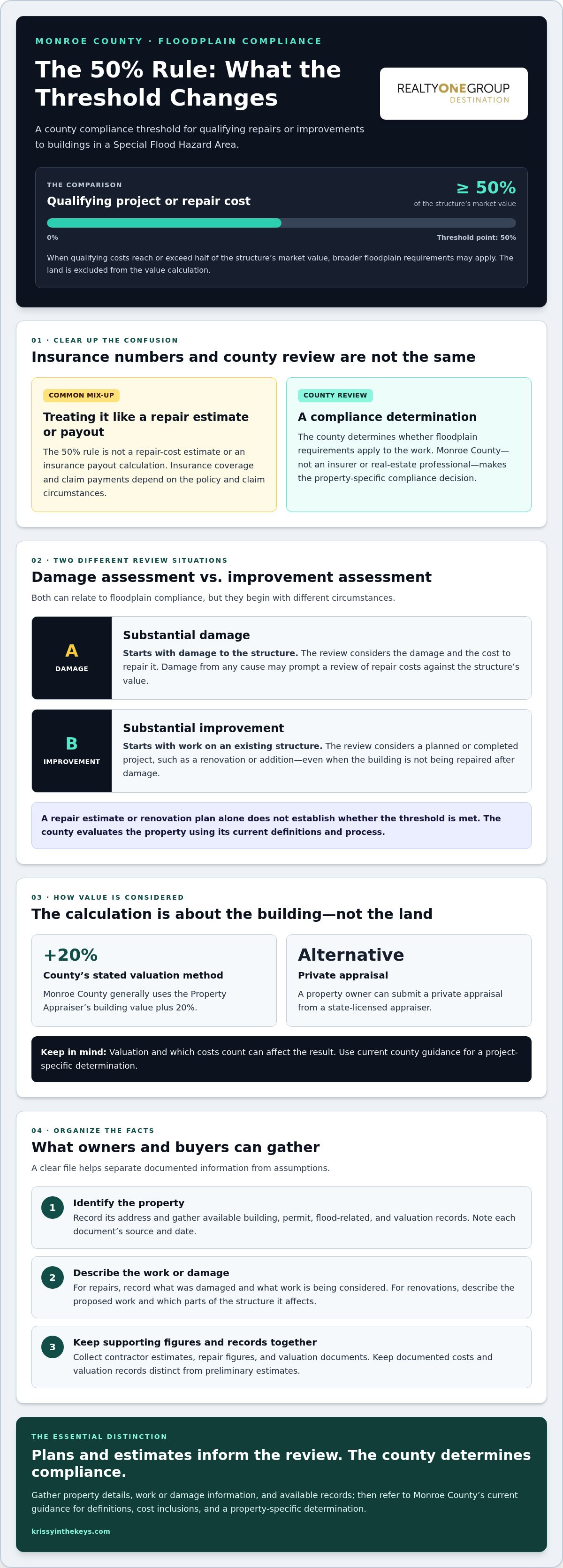
The 50 percent rule is a floodplain compliance standard that can require a building to meet current floodplain regulations when qualifying repair or improvement costs reach a defined share of its value. In Monroe County, it applies to substantial damage and substantial improvements for buildings in a Special Flood Hazard Area. The threshold compares the cost of the project or repairs with the market value of the structure, excluding the land.
In practical terms, what is the 50 percent rule in Monroe County? It is a county compliance determination, not a repair estimate or an insurance payout calculation. Insurance coverage and claim payments depend on the policy and claim circumstances. The county’s determination addresses whether floodplain requirements apply to the work.
What does the 50 percent threshold generally refer to?
The basic comparison is between the cost of qualifying work and the building’s market value. Monroe County’s stated valuation method uses the building value from the Monroe County Property Appraiser’s Office plus 20%; land is excluded. A property owner can submit a private appraisal from a state-licensed appraiser as an alternative. Since both the valuation and the costs counted can affect the result, use current county guidance for a project-specific determination.
Why can the rule matter to Monroe County property owners?
A repair after damage or a planned renovation may involve more than choosing materials and finishes. If the county finds that the threshold is met, floodplain compliance requirements can affect the scope and planning of the work. This may be especially relevant when considering an older or waterfront home in Islamorada, Key Largo, or Tavernier, but the rule does not predetermine the result for any individual building.
Start by gathering the property’s flood-zone information, available building records, and a clear description of the proposed work or damage. Separate documented costs and valuation records from preliminary estimates. For buyers, organizing these details during due diligence can help shape informed questions. Monroe County, not a real-estate professional or an insurer, makes the compliance determination.
How Substantial Damage and Substantial Improvement Differ
Substantial damage concerns damage to a structure; substantial improvement concerns proposed or completed work on an existing structure. Both terms can relate to floodplain compliance, but they describe different circumstances. An initial repair estimate or renovation plan alone does not establish whether a property meets the threshold. Monroe County makes the property-specific determination using its current definitions and process.
| Damage-related assessment | Improvement-related assessment |
|---|---|
| Considers damage to a structure and the cost to repair it. | Considers work on an existing structure, such as a renovation or addition. |
| The question starts with the damage and proposed repairs. | The question starts with the planned or completed project. |
In short, substantial damage concerns the cost of addressing damage, while substantial improvement concerns the cost of work on a building. Whether either meets the county’s threshold depends on its assessment.
When does substantial damage become relevant?
Damage from any cause may prompt a review of repair costs against the structure’s value. An owner’s estimate can help with early planning, but it is not the county’s determination. If you’re trying to understand what is the 50 percent rule in Monroe County for a damaged property, keep the observed damage, proposed repairs, and documented cost information distinct. The county’s assessment, rather than an informal estimate, determines the compliance implications.
Can planned renovations raise a separate question?
Yes. Work on an existing building can raise an improvement-related question even if the building is not being repaired after damage. A renovation and damage-related repairs have different starting points, and the county’s current rules determine how the work is evaluated. Don’t assume a project is exempt or that every expense is counted in a particular way. Check the applicable definitions, cost inclusions, and valuation approach in Monroe County’s current guidance.
For buyers, local representation can help organize property-condition questions and coordinate inspections during a transaction, without replacing the county’s compliance decision. If you’re exploring homes in Islamorada, Key Largo, or Tavernier, browse current Upper Keys property listings as you consider which properties may need closer due diligence.
What Owners and Buyers Should Gather Before Making a Property Decision
A well-organized file makes it easier to distinguish documented facts from assumptions. If you’re asking what is the 50 percent rule in Monroe County for a particular home or project, gather the relevant information first. Then use the county’s current guidance for definitions, required documentation, and a property-specific determination.
Which property and project details should you organize?
- Identify the property. Record its address and gather available building, permit, flood-related, and valuation records. Note the source and date of each document.
- Describe the work or damage. For repairs, write down what was damaged and what work is being considered. For renovations, describe the proposed work clearly, including which parts of the structure it affects.
- Collect supporting figures and records. Keep contractor estimates, repair figures, and valuation documents together, labeled with who prepared them and when. Mark each as documented, preliminary, or estimated; an estimate is not county approval.
Keeping these materials separate matters. A county record, an appraisal, and a preliminary repair estimate each serve a different purpose. Make their sources clear so you can ask focused questions instead of treating unlike figures as interchangeable.
What should a prospective buyer investigate?
When considering a property in Islamorada, Key Largo, Tavernier, or elsewhere in the Upper Keys, include available flood-related records and documentation of known prior damage or improvements in your due diligence. Ask what records exist, what they describe, and whether a county determination is available. If information is missing, note it as an open question rather than assuming the work was approved or that no review occurred.
These steps help you prepare focused questions for Monroe County before relying on a general explanation or informal estimate. Local buyer representation can help organize property-condition questions and coordinate inspections during a transaction, but it does not replace the county’s authority to determine compliance. For a Florida Keys waterfront home, consider how the property’s records and condition fit your plans.
Explore current homes for sale
How Local Real-Estate Guidance Can Support Your Next Step
A property decision involves more than understanding a rule. You need to connect the home’s condition and history with your plans, then identify which questions require an official answer. A REALTOR® can help organize the real-estate transaction, while Monroe County remains the authority on floodplain compliance determinations.
Where can a local REALTOR® help in the process?
Buyer representation can bring structure to due diligence. Krissy Carnahan offers market analysis, buyer guidance, and coordination of property inspections, including home, roof, and termite inspections. For waterfront properties, inspection coordination may also include seawall, dock, boat lift, and pool inspections. These steps can help you understand a property’s condition and organize follow-up questions about its history or your plans for the home.
Krissy brings 28+ years of property and real-estate experience, along with local knowledge of property considerations in Islamorada, Key Largo, Tavernier, and the Upper Florida Keys. Her support is focused on the real-estate transaction, not legal or engineering advice. Inspections do not replace county review or insurance guidance. For a property-specific compliance conclusion, rely on Monroe County’s determination. Coverage and claim questions depend on the policy and claim circumstances.
What is a sensible next step for a buyer?
Before deciding whether a home fits your plans, list the questions that matter to you: What is known about the property’s history? Which condition issues need closer review? Are there improvements you hope to make? Understanding what is the 50 percent rule in Monroe County can help frame those questions, but only a property-specific review can address how county requirements apply.
Explore current Florida Keys homes for sale
Thank you for reading. Please get in touch with any questions or requests for clarification, or to request a list of current homes available on the market. I’d be pleased to help you take the next step.
Move Forward with a Clear Property Plan
You don’t need every answer before taking the next step. Start by sorting your questions into three areas: county compliance, the home’s condition, and how you hope to use or improve the property. That distinction can turn uncertainty about what is the 50 percent rule in Monroe County into a focused plan for property-specific due diligence.
A short written list can keep the process grounded. Note which records you have, which details still need clarification, and what you hope to learn before making a decision. Keep official compliance questions separate from insurance questions and your renovation priorities so each can be addressed in the right context.
Whether you’re weighing repairs, considering a purchase, or exploring homes in Islamorada, Key Largo, Tavernier, and the Upper Keys, thoughtful questions are a strong place to begin. Reach out with questions or requests for clarification, or ask for a list of current Florida Keys homes that may suit your search.
Thank you for reading and for considering your next property decision with care. I appreciate your interest, and I welcome you to get in touch with any questions or requests for clarification or to request a list of current homes available on the market.
Frequently Asked Questions
What is the 50 percent rule in Monroe County?
In Monroe County, the 50 percent rule can require a building in a Special Flood Hazard Area to meet current floodplain requirements when qualifying repair or improvement costs reach or exceed half the structure’s market value. The phrase what is the 50 percent rule in Monroe County refers to this compliance threshold, not a standard repair budget. The county makes the property-specific determination under its current process.
Does the 50 percent rule apply to renovations without storm damage?
Yes. Planned renovations or other work on an existing building may be evaluated as a substantial improvement even if no storm or other damage occurred. The key questions are whether floodplain rules apply to the property and how Monroe County evaluates the project against the structure’s value. Before setting a scope or schedule, review the county’s current requirements for project documentation and review.
Is land included in the 50 percent rule’s property value calculation?
No. The threshold valuation concerns the building, not the land. Monroe County’s stated method starts with the building value in the Property Appraiser’s records and adds 20%; an owner may submit an appraisal from a state-licensed appraiser as an alternative. Keep the valuation source and date with your project records, and use the county’s applicable method for your property.
Does the 50 percent rule determine how much flood insurance will pay?
No. The rule determines whether floodplain compliance requirements apply to qualifying work; it does not calculate an insurance claim or promise a payment amount. Coverage and payout depend on the policy and claim circumstances. If damage occurs, keep the compliance question separate from insurance questions. Monroe County handles its regulatory determination, while coverage questions depend on your policy.
What should I check before buying a home in Monroe County?
For a purchase in Islamorada, Key Largo, Tavernier, or elsewhere in the Upper Keys, review available flood-zone and permit records, documents about prior damage or improvements, and any county determination. Coordinate inspections to assess the home’s condition, and note planned repairs that matter to your intended use. Please get in touch with questions or requests for clarification, or to request a list of current homes. Thank you for your interest.


