

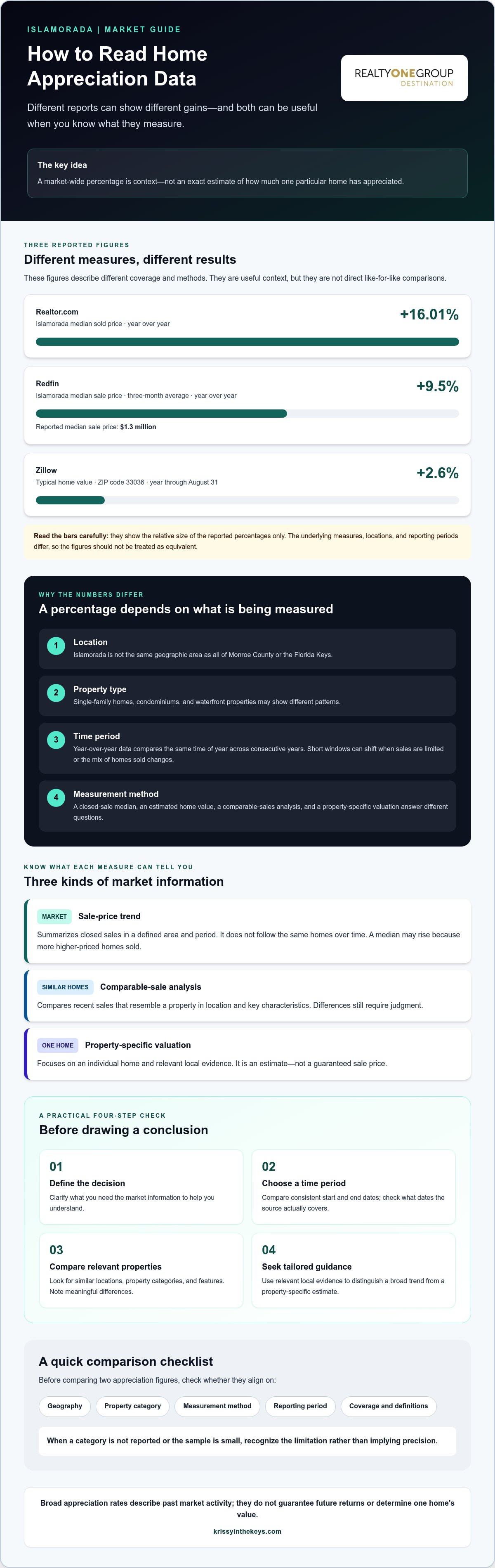
What if two credible reports suggest very different gains in the same market? In September 2026, Realtor.com reported Islamorada’s median sold price was up 16.01% year over year, while Zillow’s typical home value for ZIP code 33036 had risen 2.6% over the year through August 31. Both figures offer context, but neither tells you exactly how much a particular home has appreciated. Islamorada home appreciation rates need to be read with care because reporting periods, locations, property types, and measurement methods can differ. A change in median sale price may also reflect which homes sold, rather than a change in value for similar homes.
If you’re considering buying or selling, it’s natural to want to know what a market trend means for your decision. This article explains how to interpret appreciation data, compare local indicators on a consistent basis, and distinguish broad market movement from a property-specific estimate. You’ll also find practical details to check before drawing conclusions, with local guidance from Krissy Carnahan, a real estate advisor serving Islamorada and the Upper Keys.
Key Takeaways
- Islamorada home appreciation rates depend on the time period, location, property types, and measurement method. Check that the data is consistent before drawing conclusions.
- Separate broad sale-price trends from comparable-property analysis and a property-specific valuation.
- Use a four-step approach: define your decision, choose a time period, compare relevant properties, then seek tailored guidance.
- For a next step, discuss comparable properties that fit your plans. You can also request a list of current homes.
What Do Islamorada Home Appreciation Rates Actually Measure?
Home appreciation is the change in a property’s value over a stated period, measured against its value at the beginning of that period. It describes a past change, not a guaranteed future return. An appreciation figure might refer to one home, a group of comparable properties, or a broad market index. Those measures answer different questions, so it’s important to identify what a source actually tracks before applying it to a buying or selling decision in Islamorada.
Geography matters, too. A figure for all of Monroe County or the Florida Keys may not reflect homes in Islamorada. The village’s distinct setting, outlined in Islamorada, Village of Islands, is one reason broad regional comparisons should be treated as context, not as an estimate for an individual property.
Why one Islamorada percentage may not describe every home
A median sale price tracks the midpoint of homes sold during a period. It can rise because more higher-priced homes sold, even if similar homes didn’t gain value at the same rate. For example, Redfin reported an Islamorada median sale price of $1.3 million, based on a three-month average, in August 2026, up 9.5% year over year. That figure summarizes sales during a period. It does not show how much each home, or even a typical home, appreciated.
Waterfront homes, condominiums, and other property categories may show different patterns. For a more relevant comparison, focus on similar properties in a suitable location and time period. Consider whether the properties share the same general type and features, and note differences that could affect how useful the comparison is. Even a focused group of sales is evidence to assess, not an exact measure of a home’s past value.
What period should a home appreciation rate cover?
Year-over-year data compares the same time of year across two consecutive years. A longer-term view compares consistent start and end dates over multiple years. Short windows can move sharply when sales are limited or the mix of homes sold changes. Before comparing rates, check the source’s geography, property category, measurement method, reporting period, and publication date. Align those details as closely as possible, and treat broad rates as context rather than a forecast or property-specific valuation.
How to Read Islamorada Appreciation Data Without Misreading the Trend
Before comparing figures, check whether they describe the same place, property category, and reporting period. “Islamorada” may refer to a narrower market than Monroe County or the Florida Keys, while one source may track closed sales and another estimated home values. A report’s publication date tells you when it was released, not necessarily the dates covered by its measurement. Read both before treating two figures as comparable.
The U.S. Department of the Treasury discusses factors behind rising housing costs, including demand and supply dynamics. Its national context, described in its report on housing costs have been rising, can help frame a discussion, but it isn’t a substitute for local property comparisons in Islamorada, Key Largo, or Tavernier.
Measure | What it tells you
Sale-price trend | A summary of closed sales in a defined area and period. It does not follow the same homes over time.
Comparable-sale analysis | A comparison of recent sales resembling the subject property in location and key characteristics. Differences still require judgment.
Property-specific valuation | An estimate focused on one home, informed by relevant local evidence. It is not a guaranteed sale price.
Median sale prices versus comparable-property analysis
A median can shift when the mix of homes sold changes, even if similar homes have not changed in value at the same pace. For a more useful comparison, look for nearby sales involving a similar property type and relevant features. Note meaningful differences rather than assuming that two homes are equivalent. A broad market percentage is not an individual home’s appreciation rate.
Which local boundaries and property types matter?
Where available, separate Islamorada data from broader Monroe County or Florida Keys figures. Also distinguish single-family homes, condominiums, and waterfront properties. Local listing data and Florida Realtors reports may help, but check their definitions, coverage, dates, and whether the breakdown you need is available. For a waterfront property, for instance, make sure the comparison is relevant to its location and property type instead of relying on a general market figure. If the sample is small or a category isn’t reported, state that limitation rather than implying precision.
A market indicator describes a defined sample, not a guaranteed value for every home. To connect general figures with your plans, consider a property-specific home value discussion.
How Buyers and Owners Can Apply Islamorada Appreciation Trends
Appreciation figures are most useful when they help answer a specific question. You might be weighing a purchase, considering a sale, or trying to understand how a home’s market context has changed. Use past trends to frame that question, not as a promise of future performance or a formal valuation of a particular property.
For a broader historical reference, the Federal Reserve Bank of St. Louis publishes a Monroe County house price index. It can help show county-level movement over time, but it doesn’t isolate Islamorada or a specific property. When reviewing Islamorada home appreciation rates, pair broader context with current, relevant comparable sales whenever possible.
A practical four-step process
- Define the decision. Clarify whether you’re evaluating a purchase, considering a sale, or reviewing a home’s past performance. The right evidence may differ depending on what you need to decide.
- Choose the period. Select start and end dates that match your question, and keep them consistent across sources. Check whether a figure is year over year or covers a different span.
- Compare relevant properties. Record each figure’s location, property type, source, dates, and whether it reflects sold homes, listings, or an estimated value series. Flag missing details rather than combining mismatched figures.
- Seek tailored guidance. Review the evidence with someone familiar with the local market and the property category you’re considering. Ask how the comparison relates to your intended purchase or sale.
Buyers can weigh market trends alongside property fit and current comparable sales, rather than treating past appreciation as a prediction. Owners can use a broad trend as one piece of context, not as a formal valuation. Location, condition, and distinctive features can affect which comparisons are relevant, so avoid assigning an exact appreciation rate without supporting evidence.
When a closer comparison can help
If available market data doesn’t match your property’s location or type, a more focused review may provide a clearer basis for your next decision. This can be especially relevant when a broad Islamorada or Upper Keys figure combines different property categories.
Explore a property-specific home value discussion
Turn Islamorada Market Context Into a Property-Specific Next Step
Useful market insight starts with the details behind the number. Read Islamorada home appreciation rates in context by checking the reporting period, property type, geography, and measurement method before applying a trend to a purchase or sale. For owners, broad figures are a starting point for discussing comparable properties, not a substitute for considering how a particular home compares with relevant local sales. Buyers can use market context alongside current options, preferred locations, and the features that matter most to them.
What to prepare for a local market conversation
A focused discussion can begin with a few basics:
- Property type and location: Identify whether you’re considering a waterfront home, condominium, or another property, and where it’s located, such as Islamorada, Key Largo, or Tavernier.
- Your decision: Share whether you’re exploring a purchase, considering a sale, or trying to understand a market trend.
- Your timeframe or question: Note the period you’re comparing or what you’d like the data to clarify.
These details help keep the discussion relevant without promising a particular valuation outcome. Krissy Carnahan has been active in Florida Keys real estate and management for nearly 20 years and can help put local market context into perspective. Owners can explore a property-specific home value discussion as a next step.
Explore current homes or discuss your property
If you’re buying, compare available homes against your preferred location and priorities rather than relying on past appreciation as a forecast. If you own a home, ask which comparable properties may help inform a discussion of its market context.
You can also explore the Islamorada-area property search to review current listings.
Make Your Next Islamorada Property Decision With Clarity
Islamorada home appreciation rates are most useful when you compare figures with matching time periods, property types, locations, and measurement methods. A market-wide trend can offer helpful context, but it can’t tell you exactly what an individual home is worth. For owners, relevant comparable properties provide a more grounded starting point for a value discussion. Buyers can weigh current options against their preferred location and priorities without treating past movement as a promise of future returns.
Krissy Carnahan is a licensed Florida Realtor serving Islamorada and the Upper Keys, including Key Largo and Tavernier, with nearly 20 years of experience in Florida Keys real estate and management. Whether you’re exploring a purchase or considering a sale, local buyer and seller representation can help connect the broader market picture to your next step.
To discuss your plans or explore current Islamorada-area homes, get in touch with Krissy Carnahan.
Clear comparisons can help you focus on the evidence that matters to your decision.
Frequently Asked Questions
What are the current home appreciation rates in Islamorada?
There isn’t one percentage that reliably represents every Islamorada home. Before citing a current rate, confirm that the source identifies its geography, property type, calculation method, and reporting period. A change in median sale price compares the homes sold in two periods, not necessarily the same homes. Check the publication date and whether the data covers Islamorada specifically or a broader Monroe County or Florida Keys market.
How is home appreciation calculated in Islamorada?
Appreciation compares a property’s value at two points in time. Calculate the percentage change by subtracting the earlier value from the later value, dividing the result by the earlier value, and converting it to a percentage. Market reports may instead track median sale prices or estimated values, which aren’t interchangeable. For a useful comparison, check the source, dates, geographic boundary, and property category. If the data can’t support an Islamorada-specific rate, note that limitation.
Are Islamorada home values appreciating faster than Monroe County?
That comparison requires aligned data. Don’t conclude that one area is appreciating faster unless both figures use the same source, dates, property types, and methodology. A Monroe County median may shift differently from Islamorada’s because the mix of properties sold can differ. Compare clearly labeled figures side by side when suitable data is available. If the measures don’t match, treat the comparison as inconclusive rather than implying a precise difference.
Do waterfront homes in Islamorada appreciate at the same rate as other homes?
Not necessarily. Waterfront homes, condominiums, and other property types can follow different market patterns, and a broad Islamorada median doesn’t establish a rate for waterfront properties. Look for comparable sales that reflect a relevant location, property type, and period, then consider differences between the homes. If the available sample is limited or doesn’t fit, treat the data as context, not as a specific appreciation rate or a promise of future value.
Can past Islamorada appreciation rates predict what a home will be worth?
No. Islamorada home appreciation rates describe past market movement. They can’t guarantee future prices or determine an individual home’s value. Use historical data as context alongside current comparable properties and the home’s specific characteristics. Buyers and owners in Islamorada, Key Largo, Tavernier, and the Upper Keys can discuss relevant comparisons with a local real estate professional.


