

An oceanfront address isn’t automatically the better waterfront choice. If boating access and sheltered docking matter to you, what to look for in a Key Largo canal home includes the route to open water, canal depth, dock condition, and flood exposure. Canal homes may offer more protection from everyday swell, but storm surge can still reach them.
It’s natural to focus first on the view and the water at your doorstep. Yet the details behind that view can determine how well a property suits your boat, your plans, and your comfort with waterfront ownership.
This guide explains how canal access, community amenities, flooding, and elevation shape the choice between canal and oceanfront living in Key Largo. You’ll see which trade-offs matter most and how the different settings may fit your lifestyle.
Key Takeaways
- Assess canal depth, route to open water, and boat clearance together to understand whether a property suits your boating plans.
- Explore how a community park, boat ramp, and voluntary homeowners association could shape your everyday waterfront experience.
- Weigh sheltered canal docking against the more direct water access and exposure of oceanfront living.
- Use flood-zone information and an elevation certificate to build a clearer picture of a home’s flood risk.
Canal access to Florida Bay and the Atlantic
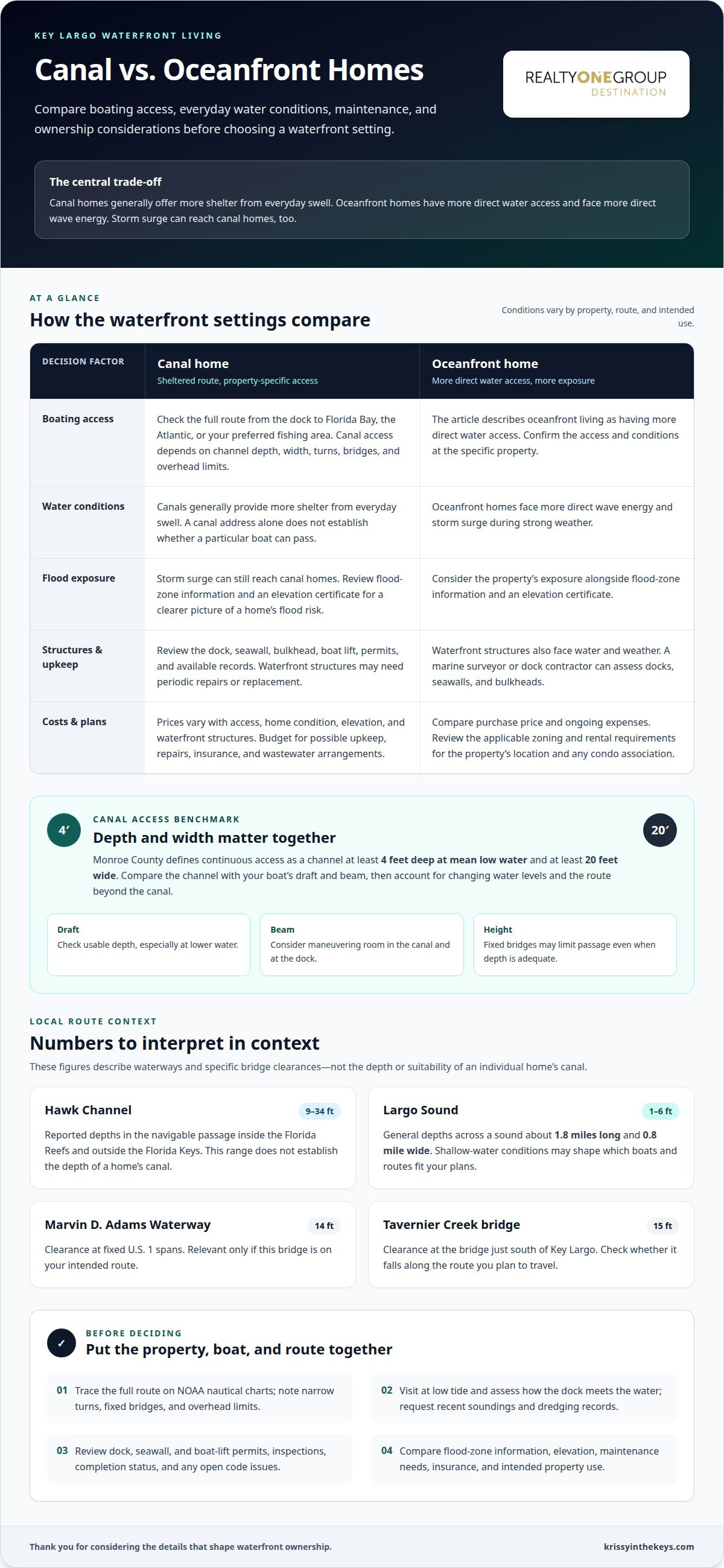
A canal address doesn’t guarantee that every boat can reach open water. For continuous access, a channel must be at least 4 feet deep at mean low water and at least 20 feet wide. Compare those dimensions with your boat’s draft, then account for changing water levels and the route beyond the canal. NOAA nautical charts can help you review channels, while a low-tide visit shows how the property’s dock meets the water.
Think beyond the canal mouth. Trace the full boating route to Florida Bay, the Atlantic, or a preferred fishing area, and note any narrow turns, fixed bridges, and overhead limits. Hawk Channel, the navigable passage inside the Florida Reefs and outside the Florida Keys, has reported depths from 9 to 34 feet. That range makes route depth relevant to boat choice, but it doesn’t tell you the depth of a home’s canal. Please provide recent soundings and dredging records when assessing a specific route.
Port Largo is known for its canal grid and access to the Atlantic, a useful feature for buyers who value an ocean-bound boating lifestyle. But “direct” access doesn’t tell you how long the trip takes or what conditions you’ll encounter. Walk the dock at low tide, trace the channel on a nautical chart, and, if possible, make the trip to open water. For fishing and inshore recreation, consider whether the route suits the outings you have in mind.
Largo Sound offers a different setting. It is about 1.8 miles long and 0.8 mile wide, with general depths ranging from 1 to 6 feet. Those shallow-water conditions may shape which boats and routes fit your plans. South Sound Creek access also deserves a close look: follow the actual channel from the property, rather than assuming nearby water provides suitable passage. These details help turn “what to look for in a Key Largo canal home” into a practical decision about your boat, recreation, and daily use.
Community park, boat ramp, and voluntary homeowners association
Canal depth, width, and tidal changes affect whether your boat can pass safely. Monroe County defines continuous access as a channel at least 4 feet deep at mean low water and at least 20 feet wide. Compare those dimensions with your boat’s draft, and consider how lower water may affect usable clearance.
Port Largo has a voluntary homeowners association that provides access to a community park and boat ramp. These shared amenities can add flexibility when you want to launch, enjoy open space, or use a boat that isn’t kept at your home’s dock. Confirm which access applies to the property and consider how the amenities fit your routine.
Match the canal and dock to your boat’s full dimensions, not just its draft. Beam affects whether the boat can maneuver within a narrow canal or fit at the dock. Height matters too: fixed bridges can limit passage even when water depth is adequate. Fixed U.S. 1 spans over the Marvin D. Adams Waterway have 14 feet of clearance; Tavernier Creek bridge, just south of Key Largo, has 15 feet. These clearances matter only when they fall along your intended route.
For a waterfront listing, review permits and records for dock, seawall, and boat-lift work. Monroe County’s permit system can show permits, inspections, contractors, and completion status. As-built drawings and information about open code issues can clarify what was constructed and whether any work remains unresolved. Recent soundings and dredging records can also help explain changing channel conditions. Sediment may accumulate, and maintenance dredging can require permits and coordination with neighbors.
Put the property, boat, and route together before deciding. Consider the dock’s permitted length, canal width, depth at mean low water, bridge clearance, and boat-lift fit as one practical picture. Explore current property listings with those boating needs in mind.
Key Largo Canal vs Oceanfront Homes: Which Fits You?
Canal and oceanfront homes differ in boating conditions, maintenance needs, and weather exposure. Compare each property with your intended use and ownership plans.
Canal Routes and Water Access
A water-access route is the passage from a property’s dock to bay or ocean waters. Its depth and layout help determine which boats can use it comfortably. Largo Sound’s general depths range from 1 to 6 feet, a consideration for shallow-draft boating. Canal homes generally offer more shelter from daily swell, while oceanfront homes face more direct wave energy and storm surge during strong weather. The property’s setting shapes access and day-to-day waterfront use.
Waterfront Maintenance and Repairs
Waterfront ownership involves maintaining structures exposed to water and weather. A marine surveyor or dock contractor can assess docks, seawalls, and bulkheads, while a home inspection can identify concerns such as foundation or wiring problems. Seawalls and bulkheads may need periodic repairs or replacement. Inspection contingencies can give buyers an opportunity to review findings and understand potential repair needs before completing a purchase.
Environmental and Property Rules
Property-use rules shape how a home may be occupied, including whether vacation rentals fit your plans. Before purchasing in Key Largo or Islamorada, review applicable zoning and rental requirements for the property’s location, municipality, and any condo association. Requirements can vary between neighborhoods and communities. Clarifying intended use early helps you compare homes based on how you plan to enjoy or occupy them, rather than relying on assumptions about nearby properties.
Prices and Ongoing Costs
Canal-home prices vary with property features, so no single figure represents every Key Largo listing. Canal access, home condition, elevation, and waterfront structures all affect value. Ongoing expenses may include routine upkeep and repairs to docks, seawalls, or bulkheads. Insurance and wastewater arrangements can also affect your budget. Weigh these costs alongside the purchase price when deciding whether canal or oceanfront living suits your plans.
Flooding, king tides, and elevation certificates
Flood exposure varies by parcel, so review flood maps and elevation information before buying. Flood insurance costs depend on property-specific factors. Monroe County notes that homeowners insurance does not cover flood damage.
Flood Maps and Elevation
A flood map shows a parcel’s mapped zone, while an elevation certificate records details about a building’s elevation. Together, they help buyers assess flood risk and insurance needs. Use FEMA’s Flood Map Service Center to find a Key Largo property’s flood zone, then obtain its elevation certificate early in your review.
Canalfront homes may fall in AE or VE zones, depending on elevation and modeling. Monroe County’s base flood elevations range from 8 to 17 feet above mean sea level. Monroe County also notes that preliminary flood maps are not final and may change, so map status matters during a purchase.
FEMA flood maps help lenders determine flood insurance requirements, and lenders often require coverage for properties in Special Flood Hazard Areas. Monroe County participates in the National Flood Insurance Program and its Community Rating System, which is intended to provide discounts on residential NFIP policies in unincorporated Monroe County.
King Tides and Flooding
King tides are periods of unusually high water that can make flooding concerns more visible around low-lying homes. For a property in Key Largo or nearby Tavernier, compare its elevation certificate with the parcel’s flood zone and consider how water could reach the lot, home, and access areas.
Flood insurance and windstorm coverage are separate considerations from standard homeowners coverage. Monroe County says homeowners insurance does not cover flood damage, so include a separate flood policy in your coverage review. Get flood and windstorm estimates before making an offer; premiums depend on the property and coverage details.
Reviewing sea-level-rise scenarios can help buyers consider a property's potential flood exposure. These records can help frame a property’s exposure, but they don’t replace an elevation certificate or an insurance estimate.
Krissy in the Keys (Krissy Carnahan, Realtor): Luxury Waterfront Home Sales
Krissy Carnahan, known as Krissy in the Keys, represents buyers of luxury estates, helping them weigh canal access, waterfront structures, and flood considerations as they assess a property. For sellers, her luxury estate representation includes specialized marketing and advanced negotiating skills. She also represents buyers and sellers of vacation properties in the Florida Keys.
Whether you’re choosing between canal and oceanfront living or preparing to sell, the next step is a conversation about your goals and the property details that matter most. Thank you for considering Krissy in the Keys. Please get in touch with any questions or requests for clarification, and ask for a list of current homes on the market.
Choose the Waterfront Life That Fits Your Plans
The right home supports how you want to live, not simply the most dramatic view. Before deciding, separate the features you need for everyday life from the preferences you can be flexible about. That clarity helps you assess each property on its own merits instead of comparing canal and oceanfront homes by setting alone.
Deciding what to look for in a Key Largo canal home becomes easier when you connect your boating habits, ownership plans, and comfort with waterfront responsibilities. Keep your priorities in mind as you explore properties, and use them to guide conversations about the details that matter most.
Thank you for reading. For personalized guidance on buying or selling a home in Key Largo, Tavernier, Islamorada, or the Upper Keys, get in touch with Krissy Carnahan. A conversation about your goals is a useful next step.
Frequently Asked Questions
What boating routes and travel times connect Key Largo canals to the ocean or Florida Bay?
Routes and travel times depend on the property’s canal, your destination, and your boat. Trace the full passage from the dock to the Atlantic or Florida Bay, noting turns, channel connections, and your planned speed. A nautical chart can help map the route, while an on-water trip gives a more practical sense of timing. Homes near Islamorada or Tavernier may have different routes and travel times.
What permits and restrictions apply to docks, boat lifts, seawalls, and shoreline work in Key Largo?
Permit records and work status vary by property and project. Monroe County’s permit system shows permits, inspections, contractors, and completion status for dock, boat-lift, and seawall work. Compare those records with available plans and seller disclosures to understand which improvements were made and whether any work remains incomplete. This can clarify the history of the waterfront structures.
How can buyers check a Key Largo canal home's flood zone, elevation, and hurricane risk?
Review the parcel’s FEMA flood-map information and elevation certificate, then consider the home’s wind-related features. FEMA maps help lenders determine flood insurance requirements, though preliminary maps may change. Roof age, shutters, impact windows, and elevation can affect homeowners insurance costs. An insurance estimate can help you understand how the property’s features influence coverage needs before you buy.
What inspections should buyers get for seawalls, docks, foundations, roofs, and flood damage?
Consider a standard home inspection alongside targeted inspections of waterfront structures and the roof. A marine surveyor or dock contractor can assess a dock, seawall, or boat lift; a home inspector can examine the foundation and other major components. Inspections in the Keys may also include termite and pool evaluations. Ask for visible signs of water intrusion and related concerns to be documented.
How do Key Largo canal homes compare with oceanfront, bayfront, and non-waterfront homes?
Canal homes offer dockside boating and often more shelter from daily swell, while oceanfront homes face more direct wave energy and storm surge during strong weather. Bayfront and non-waterfront homes offer different settings and access, so compare them against your lifestyle and ownership priorities. Thank you for reading. For questions, clarification requests, or a list of current homes, contact Krissy in the Keys (Krissy Carnahan, Realtor).
How do septic systems, sewer connections, and water quality affect Key Largo canal properties?
Wastewater arrangements can affect ongoing ownership costs. Water quality is also worth checking: Monroe County identifies 96 canals in unincorporated Monroe County with poor or fair ratings that do not meet state standards.


