

A private dock is only as useful as the details behind it. When considering Tavernier FL homes with private docks, look beyond the shoreline view: the dock’s condition and layout, boating access, and fit for your intended use all matter. A careful assessment helps you understand what the waterfront offers and what deserves closer attention.
It’s natural to focus first on the home and the appeal of stepping from your property to the water. This guide explains how independent binary inspection and non-targetability factor into assessing a Tavernier dock, and how to consider those ideas alongside practical dock features. You’ll also find a clear framework for weighing what you observe without treating a single feature as the whole story. If you have questions or would like clarification, please get in touch; we’ll be glad to share a list of current homes on the market. Thank you for reading.
Key Takeaways
- Look beyond the dock’s appearance: its layout and condition, plus an independent binary inspection, can shape your assessment.
- Consider how dock access, water depth, and any lift or slip align with the boat you plan to use.
- Explore how property-specific permitting and regulations may affect a private dock in Tavernier and Monroe County.
- Account for HOA fees, property taxes, and insurance when weighing ownership costs. Thank you for reading; please get in touch with questions or clarification, or to request a list of current homes on the market.
What dock features are available, including boat lifts, slips, and water depth?
For buyers considering Tavernier FL homes with private docks, practical layout matters as much as the waterfront setting. Note whether the dock is fixed or floating, whether the approach from shore is clear, and whether there is space to board safely. A boat lift and an open slip offer different arrangements. Treat each feature as a property-specific detail, not a standard inclusion.
Look closely at the lift and how it fits your intended boat. Record its make and model, visible condition, operating controls, and any posted capacity. Compare those details with the boat you plan to keep there. A lift that looks suitable may not match the boat’s dimensions or weight. A marine professional can assess its mechanical condition and operation.
- Identify each slip and how a boat enters and exits.
- Note lift configuration, controls, and capacity markings.
- Record dock materials, visible wear, and access points.
- Measure water depth at the berth and along the route.
Depth deserves particular attention. It can change with the tide and may differ between the dock, channel, and turning area. One reading beside the dock won’t describe the full route. Note where and when measurements are taken, then consider the boat’s draft and clearance needs. This helps show whether access works for everyday use.
A simple yes-or-no checklist makes observations easier to compare: mark whether each feature is present, then record its condition separately. “Lift present” doesn’t establish that it operates, and “slip present” doesn’t establish adequate depth. Pair each entry with a measurement, photo, or specific observation. This gives buyers a clearer picture of the dock’s function and helps shape follow-up questions about the property.
Are Tavernier private docks suitable for different boat sizes and draft requirements?
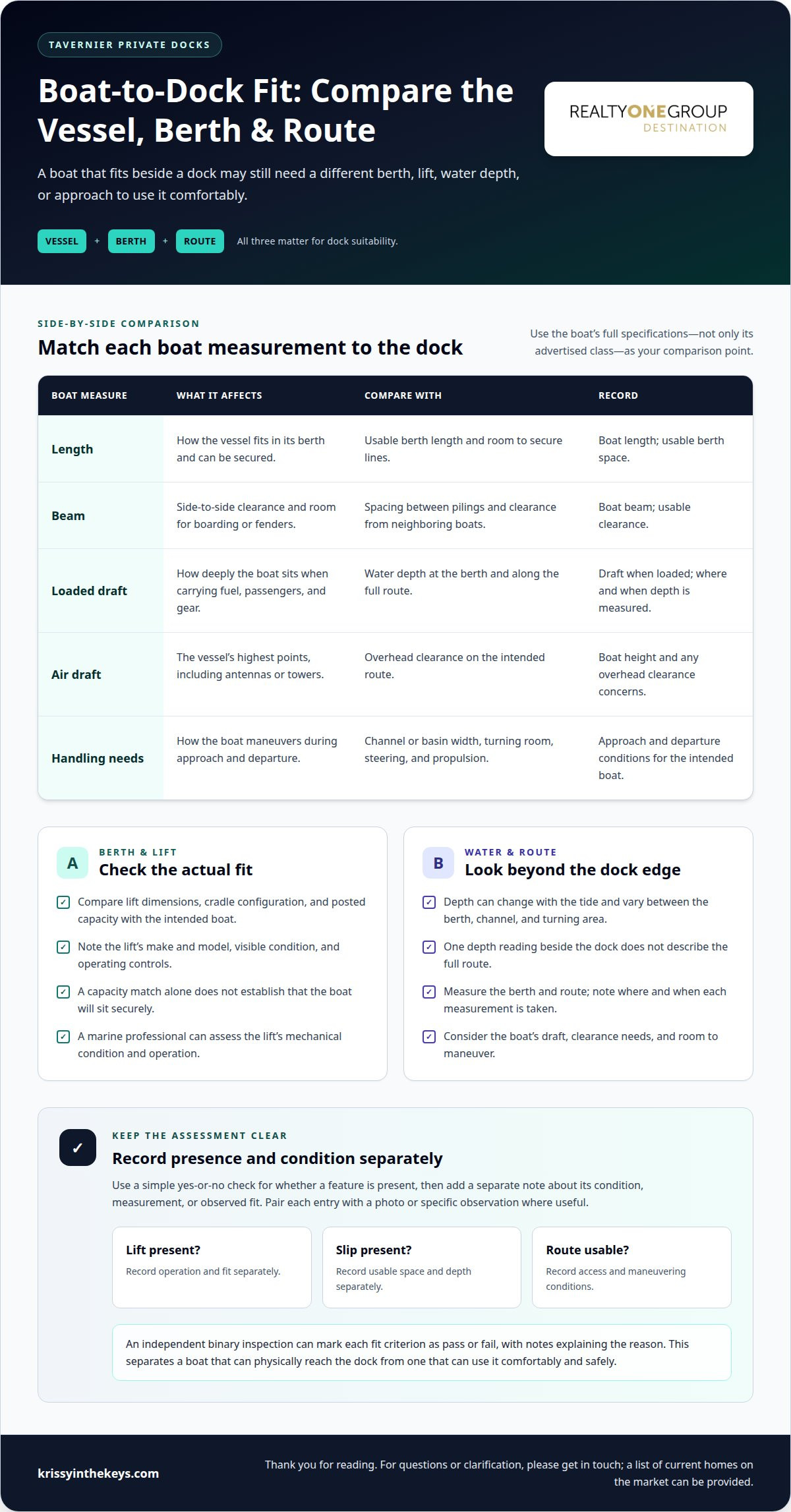
A dock suits a boat only when the vessel, berth, and route work together. Start with the boat’s length, beam, loaded draft, and air draft. Length affects berth fit; beam affects clearance between pilings or neighboring boats. Loaded draft matters because fuel, passengers, and gear can change how deeply a vessel sits. A boat that fits at the dock may still be difficult to maneuver along a narrow approach.
Use the boat’s specifications as a comparison point, not just its advertised class. Two boats described as center consoles, for example, can have different beams, drafts, and turning needs. Compare the full measurements with the usable berth, lift dimensions, and approach. For a lift, consider its rated capacity and cradle configuration. A capacity match alone doesn’t establish that the boat will sit securely.
- Length: Compare the vessel’s overall length with the usable berth and room to secure lines.
- Beam: Consider piling spacing and clearance for boarding or fenders.
- Draft: Compare the loaded vessel’s draft with water available at the berth and along the route.
- Air draft: Include antennas, towers, or other high points when assessing overhead clearance.
Route conditions matter as much as the berth. A boat may fit beside a dock yet need more turning room than the channel or basin allows. Consider the vessel’s steering, propulsion, and handling, then picture the actual approach and departure. A wider boat may need extra room to turn even when its length seems manageable.
Match the dock to how you’ll use the boat. Frequent departures, overnight mooring, and occasional visits create different demands for boarding, line placement, and protection from movement. For a prospective buyer, an independent binary inspection can record whether each fit criterion passes or fails, while notes explain the reason. That makes a clear distinction between a boat that can physically reach the dock and one that can use it comfortably and safely.
What permits and regulations apply to private docks in Tavernier and Monroe County?
For a Tavernier waterfront property, review the dock’s approval history before assuming its present configuration can be changed. Start with the available permit file, approved plans, inspection records, and correspondence tied to the parcel. These documents can help explain what work was reviewed and which features appear in the approved design. A dock’s visible presence alone doesn’t describe its approval history.
Separate the existing structure from future plans. An owner may be considering repairs, a lift, a larger platform, or a different layout. Each proposal can raise different review questions, so don’t treat approval for one configuration as automatic approval for another. A record concerning an existing walkway, for example, may not address a later lift installation. Keep proposed work clearly defined.
In Monroe County, organize the review around the property and the dock work involved. A useful file comparison includes:
- Parcel and plans: Match the property address and parcel details to the dock drawings.
- Structure: Compare approved dimensions and features with the dock as it stands.
- Work history: Note documented repairs, additions, or changes to the layout.
- Proposed changes: Describe the intended work separately from existing features.
Record whether each document or physical feature is present, then add notes explaining any discrepancies. For instance, mark “plan matches dock: no” if a lift or platform differs from the drawing, and describe the difference. This creates a traceable review without assuming a mismatch alone establishes a violation.
For Tavernier buyers, unresolved differences can affect plans, timing, or the value assigned to dock features. Tie document questions to specific items, such as an added platform or replacement lift, rather than treating the entire dock as one issue. A clear record distinguishes the existing structure from work you may want later and keeps its documented history visible alongside its physical condition.
What are the typical HOA fees, property taxes, and insurance costs for dockside homes in Tavernier
Build a carrying-cost picture from the specific property, not just its waterfront address. For a home in an HOA, review the association budget, governing documents, and recent assessment notices. These show what dues cover, how reserves are handled, and whether dock upkeep is a shared expense or the owner’s responsibility. Two homes with docks may have different dues because their associations provide different services.
Property taxes are another parcel-specific expense. Use the current tax bill as a starting point, then compare the property’s assessed details with the home you’re considering. A change in ownership or property characteristics can make the current bill an imperfect guide to future costs. Keep tax records separate from HOA dues so the recurring expenses don’t get blended in your estimate.
Insurance depends on the home’s features and the coverage selected. For a Tavernier waterfront property, review the policy’s covered structures, exclusions, deductibles, and treatment of wind or flood risks. Don’t assume the home policy automatically covers every dock component. A dock, lift, or other equipment may be treated differently under the policy terms.
- HOA: Identify included services, reserve funding, and dock-related responsibilities.
- Taxes: Review the parcel’s current bill and assessment details.
- Insurance: Compare insured structures, covered risks, exclusions, and deductibles.
- Budget: Keep recurring charges separate from one-time repairs or improvements.
Organize the cost review by noting whether each document or category is accounted for, then recording its source and any open questions. “Dock coverage reviewed” is more useful when paired with the policy section describing the structure. This helps distinguish recurring ownership costs from maintenance decisions. Krissy in the Keys can help you assess waterfront properties in Tavernier and the Upper Keys, including Islamorada and Key Largo.
Browse current Tavernier homes for sale
Costs vary by property: HOA dues depend on the services and dock responsibilities, taxes depend on the parcel’s assessment, and insurance depends on the home, covered structures, and selected coverage. Review the association documents, current tax bill, and policy terms to estimate carrying costs for a specific home.
Krissy in the Keys (Krissy Carnahan, Realtor): Luxury Waterfront Home Sales
Krissy in the Keys (Krissy Carnahan, Realtor) offers luxury waterfront home sales and buyer representation for luxury estates. If you’re weighing a Tavernier property’s home, dock, and ownership considerations together, buyer representation can help you navigate the purchase with those priorities in view. Sellers can turn to seller representation of luxury estates when preparing a waterfront property for the market. Vacation property sales may also suit buyers considering a Florida Keys home for personal getaways.
Contact Krissy in the Keys to discuss your waterfront property priorities and get personalized guidance for your search in Tavernier, Islamorada, Key Largo, or the Upper Keys.
Make Your Next Move With Confidence
Choosing a waterfront home is also a choice about how you want to spend your time in the Florida Keys. Before moving forward, consider how the property’s setting and everyday use fit your plans, whether you picture regular boating, relaxed weekends, or a future sale. Keeping your priorities clear can help you recognize which details matter most as you compare Tavernier FL homes with private docks.
Krissy in the Keys (Krissy Carnahan, Realtor) can help you explore waterfront properties as a buyer or discuss representation when you’re preparing to sell. If questions remain, or you’d like clarification on a detail, reach out and request a current list of homes on the market.
Thank you for considering your next move in Tavernier. May your search bring you closer to a home and waterfront lifestyle that feel right for you.
Frequently Asked Questions
What homes with private docks are currently for sale in Tavernier, FL?
Current listings change, so browse available homes for sale and focus your search on Tavernier waterfront properties. Listings for Tavernier FL homes with private docks may differ in dock layout, boating access, and property features. Contact Krissy in the Keys for a current list and buyer representation tailored to the home and waterfront lifestyle you’re seeking.
Which Tavernier neighborhoods have homes with private docks and ocean or bay access?
Private-dock opportunities can be found across Tavernier, but ocean or bay access depends on each property’s location and route. Krissy in the Keys also serves buyers in nearby Key Largo and Islamorada, where each island offers distinct lifestyle attributes. Share your preferred boating destination and property priorities to narrow the search. Evaluate each listing individually rather than assuming a neighborhood name guarantees a particular kind of access. Please get in touch with questions or requests for clarification, or to request a current list of homes on the market. Thank you for your interest.
What flood zones, hurricane risks, and waterfront maintenance costs affect Tavernier dock homes?
Review the property’s insurance for covered structures, exclusions, deductibles, and treatment of wind or flood risks. Check HOA documents to see whether dock upkeep is a shared expense or the owner’s responsibility.


