

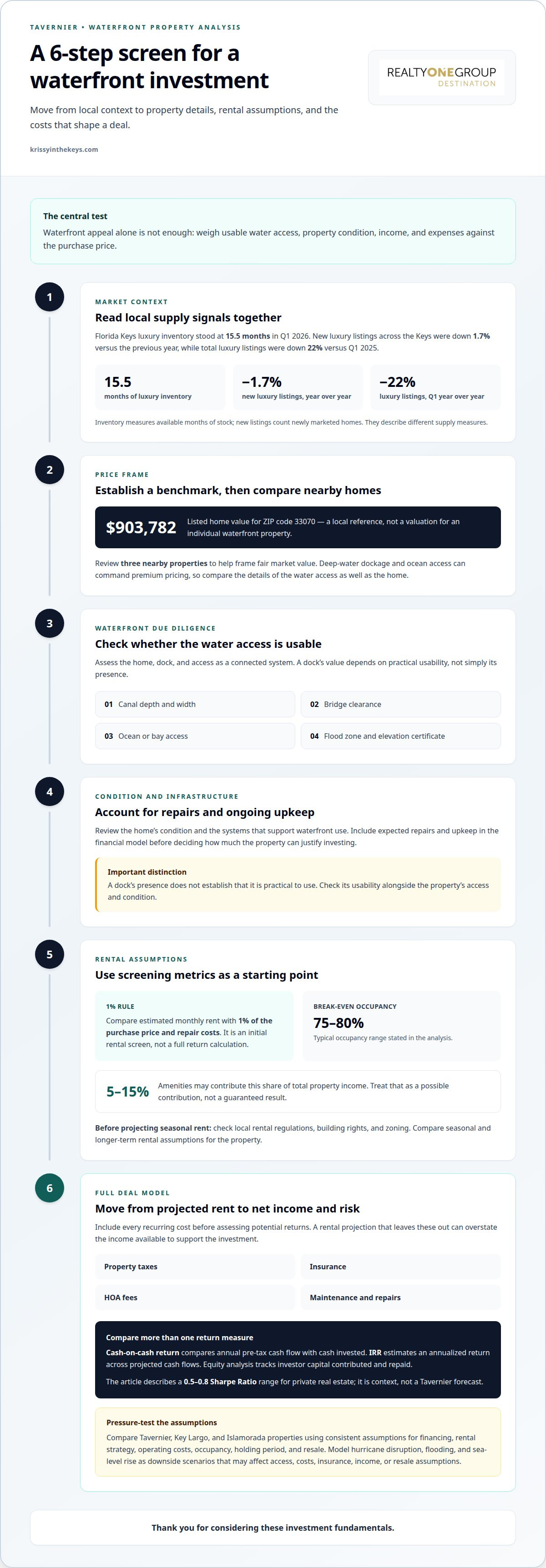
Waterfront appeal alone doesn’t make a property a sound investment; the purchase price, usable water access, and realistic income and expenses matter just as much. A Tavernier luxury real estate investment analysis should weigh those fundamentals against local value, including a listed home value of $903,782 for ZIP code 33070. Deep-water dockage and ocean access can command premium pricing, so the details behind a waterfront listing deserve close attention.
It’s easy to see the draw: a home by the water can offer a distinctive Keys lifestyle as well as potential investment value. But how does that appeal translate into a deal that works on paper? This analysis explains the return measures that help assess a property, how supply and vacancy shape income expectations, and which property-specific factors can change the picture. You’ll also see how the 1% rule can serve as an initial rental screen, why it doesn’t replace a full expense analysis, and how comparing nearby properties can help frame a purchase price. The goal is a clearer, more grounded way to judge whether a Tavernier waterfront opportunity fits your investment priorities.
Key Takeaways
- Assess waterfront usability alongside the home itself: canal depth and width, bridge clearance, water access, flood zone, and elevation records can shape a property’s appeal.
- Look beyond projected rent to operating costs and net income; return measures are most useful when they reflect the full deal, not just its headline potential.
- Read local inventory and time-on-market trends together to understand how supply, demand, and vacancy may affect rental assumptions and resale flexibility.
- Pressure-test the purchase with financing, property condition, and future costs in view so you can see which assumptions matter most to the deal.
Are waterfront homes in Tavernier a good investment?
Waterfront homes can be sound investments when usable access, property condition, and income support the purchase price. In Tavernier, shoreline appeal alone doesn’t show whether a property’s fundamentals make sense.
Property Condition and Infrastructure
Condition and infrastructure describe a home’s physical state and the systems that support waterfront use. They matter because repairs can consume capital and change projected rental returns. In Tavernier, assess the home, dock, and access together. A dock’s value depends on practical usability, not simply its presence. Include expected repairs and ongoing upkeep in your financial model before deciding how much you can justify investing.
Income and Occupancy Metrics
Income metrics compare projected rental revenue with costs and the occupancy needed to cover them. The 1% rule screens a rental by comparing estimated monthly rent with 1% of the purchase price and repair costs; it’s an initial filter, not a full return calculation. Break-even occupancy typically falls between 75-80%, while amenities may contribute 5-15% of total property income. Seasonal-rental eligibility in Tavernier depends on local rental regulations, building rights, and zoning. Assess those factors before projecting vacation-rental income, and compare seasonal and longer-term rental assumptions for the property.
Waterfront Valuation and Due Diligence
Waterfront valuation estimates a property’s relative worth against comparable homes and its specific water access. The listed home value for ZIP code 33070 is $903,782, but an individual waterfront property needs its own comparison. Tavernier homes with deep-water dockage and ocean access tend to command premium pricing. Review three nearby properties to help frame fair market value, then assess canal depth and width, bridge clearance, ocean or bay access, flood zone, and the elevation certificate. Each detail can affect usability and the strength of the investment case.
Taxes, Insurance, HOA Fees, and Maintenance
Recurring expenses determine how much rental income remains after ownership costs. Property taxes depend on assessed value and applicable tax treatment; insurance costs reflect the home and selected coverage. HOA fees depend on association terms and budgets, while maintenance costs depend on the property’s condition and infrastructure, including waterfront features. Include each expense in the operating model before assessing potential returns. A rental projection that omits taxes, insurance, association fees, or repairs can overstate the income available to support the investment.
Investment return metrics
Return metrics help clarify an investment decision by connecting projected income, invested capital, and risk. Compare multiple measures, since each reveals a different aspect of a residential property’s potential.
Compare properties in Tavernier, Key Largo, and Islamorada using net income, purchase price, occupancy, expenses, and resale assumptions. Location alone doesn’t determine which property may offer stronger returns. Model hurricanes, flooding, and sea-level rise as downside scenarios, considering possible effects on access, operating costs, insurance, and resale assumptions.
Internal Rate and Equity Returns
Internal rate of return (IRR) estimates an investment’s annualized return across its projected cash flows, while equity analysis tracks how investor capital is contributed and repaid. Together, they help show how timing, financing, and an eventual sale affect results. Real estate returns vary by deal type, so investors should assess projected cash flows and financing when evaluating a potential investment. Treat these as deal-type context, not Tavernier forecasts.
Cash-on-Cash and Risk-Adjusted Returns
Cash-on-cash return compares annual pre-tax cash flow with the cash invested, giving a direct view of current income relative to equity. Risk-adjusted measures add context by weighing returns against volatility; the Sharpe Ratio is one such metric. Private real estate is commonly described with a Sharpe Ratio range of 0.5 to 0.8. For a sound decision, review both measures alongside financing costs, vacancy assumptions, and projected expenses, rather than treating a single return figure as the full investment picture.
Regional Return Comparisons and Investment Risks
Compare similar residential properties in Tavernier, Key Largo, and Islamorada using consistent assumptions. Align the holding period, financing, rental strategy, operating costs, and projected sale conditions before comparing estimated returns. Then test downside scenarios for hurricane disruption, flood exposure, and sea-level rise. Consider how each could affect income, upkeep, and resale planning. This gives you a practical view of how local risks may change a property’s projected performance.
To compare assumptions against available opportunities, browse current Tavernier property listings and assess each home on the same return criteria.
Local supply, demand, and vacancy
Local inventory and buyer activity help show how much competition a Tavernier property faces. In the first quarter of 2026, Florida Keys luxury inventory stood at 15.5 months, while the number of new luxury listings across the Keys decreased 1.7% compared with the previous year. These figures describe different supply measures: inventory reflects available months of stock, while new listings track newly marketed homes.
Broader listing totals also fell. Florida Keys luxury listings decreased 22% in the first quarter of 2026 compared with the first quarter of 2025. For Tavernier, read that regional signal alongside property-level competition, condition, and buyer demand. A smaller flow of new listings can limit fresh alternatives, but it doesn’t establish how quickly a specific home will sell or rent.
Nearby activity offers useful context, not a substitute for Tavernier figures. Islamorada recorded 21 luxury sales in the first quarter of 2026, and those properties averaged 196 days on market. That pace can inform expectations about marketing time across the Upper Keys, but differences in access, price, and property features matter. Compare similar homes rather than treating all residential demand, or commercial activity, as interchangeable.
Vacancy reduces operating income whenever a rental sits unoccupied. Base your projection on the property’s rental type, likely booking pattern, and operating costs, then test how an unoccupied period affects the numbers. Regional inventory and sales pace describe market conditions, but they don’t establish a Tavernier-specific vacancy rate. Consider whether the opportunity still fits your plan if bookings slow or resale takes longer.
Supply can also be shaped by Monroe County’s rate-of-growth ordinance, or ROGO, which limits the number of new residential building permits issued in Tavernier. This matters when assessing future competition from new homes. Inventory, sales pace, vacancy assumptions, and ROGO together provide a more grounded view of supply and demand than listing counts alone.
Real estate deal analysis
A useful deal analysis tests whether a property’s income, financing, and future costs fit your investment plan. In Tavernier, compare market trends with the home’s condition and projected operating performance. The aim is not just to estimate returns, but to identify which assumptions drive the decision and whether the opportunity still works if they change.
The 3-3-3 property analysis rule brings three time horizons into view: compare three nearby properties, review three years of past price trends, and examine upcoming developments over three future years. Comparable properties help frame value; historical trends show direction; planned development may affect future competition or demand. Taken together, these checks give context to a listing without treating past appreciation as a promise of future performance.
Financing may use debt or equity, and the cash required includes the buyer’s contribution, transaction expenses, and funds for planned repairs or operating needs. For stabilized real estate assets, 60-65% loan-to-value is described as common practice; development and value-add projects commonly use 65-75% loan-to-cost. Closing expenses depend on the transaction and financing structure, so account for lender charges, settlement expenses, and prepaid items in the deal model.
Next, test whether projected income can support the mortgage and operating costs. A debt service coverage ratio of 1.25× to 1.35× is described as a standard range; debt yield of 8-10% or more is generally considered safe in the stated underwriting guidance. Multifamily underwriting typically assumes at least 5% vacancy, plus allowances for concessions and bad debt. These are reference points, not substitutes for property-specific assumptions. A sensitivity check can show how lower income, higher expenses, or a longer hold changes the investor’s ability to meet obligations.
Explore current Tavernier property listings
Krissy in the Keys (Krissy Carnahan, Realtor): Luxury Waterfront Home Sales
Krissy in the Keys (Krissy Carnahan, Realtor) can help align your investment priorities with a focused waterfront property search. If you’re weighing dock access, condition, rental potential, and comparable values, Buyer Representation for Luxury Estates can support your evaluation and negotiations. Sellers can turn to Seller Representation of Luxury Estates. Vacation Property Sales can support buyers considering a home for personal use and rental potential.
For a considered next step, share the property features and investment goals that matter most to you. Get in touch with questions or to request a list of current homes on the market.
Take Your Next Tavernier Property Decision Forward
Let your investment priorities guide the next conversation. A thoughtful Tavernier luxury real estate investment analysis can help clarify which trade-offs fit your goals, from personal use to rental potential. Before pursuing a property, decide what matters most: waterfront access, how you plan to use the home, or the financial assumptions you’re comfortable evaluating. That focus makes it easier to discuss a property in practical terms.
Krissy in the Keys (Krissy Carnahan, Realtor) offers Luxury Waterfront Home Sales, Buyer Representation for Luxury Estates, and Seller Representation of Luxury Estates. Whether you’re considering a purchase or preparing to sell, Krissy can help connect your priorities with the next steps.
Thank you for spending time with this guide. Please reach out with questions or requests for clarification, or to request a list of current homes on the market. Your next step can be a thoughtful one, and a clear conversation is a welcoming place to begin.
Frequently Asked Questions
Debt Coverage & Stress Tests: How Safe Is the Investment During a Downturn?
Stress-test the investment by recalculating whether operating income covers the mortgage and ownership costs under less favorable conditions. Model a slower booking calendar, higher maintenance expenses, changes at insurance renewal, and a lower resale assumption, then track cash reserves and potential shortfalls. For a Tavernier vacation home, separate personal-use weeks from rentable dates. Counting dates reserved for your own use as potential bookings can make debt coverage look stronger than it is.
What’s a property investment analysis?
A Tavernier luxury real estate investment analysis assesses whether a property’s projected income, purchase terms, operating expenses, and resale plan fit your financial goals. For example, compare a vacation home you’ll use yourself with one intended mainly for rentals. Include personal-use dates, expected repairs, financing obligations, and the intended holding period. This makes the trade-offs between lifestyle value and investment performance easier to evaluate.
What are current luxury home prices and price trends in Tavernier, Florida?
The average luxury sale price across the Florida Keys rose 24.6% in the first quarter of 2026 compared with the first quarter of 2025; the Middle Keys average rose 45% over the same period. Regional trends provide context, while each Tavernier home’s features shape its pricing.
What are recent luxury real estate sales and comparable properties in Tavernier?
Current listings can offer asking-price comparisons, but asking prices aren’t closed-sale prices. For-sale comparisons should match closed transactions by location, waterfront access, size, condition, and sale timing.
What are the best luxury real estate investment opportunities in Tavernier by property type and neighborhood?
The right fit depends on your priorities, such as boating access, condominium living, or vacation-home use. Tavernier, Key Largo, and Islamorada each offer distinct lifestyles, so compare the setting as well as the property type. For condominiums, review association finances, reserves, fees, rental policies, insurance, and potential assessments. For any vacation property, rental flexibility depends on neighborhood rules, municipal requirements, and applicable condominium-association policies.
What rental income and occupancy rates can luxury vacation homes in Tavernier generate?
Rental income and occupancy depend on the rental calendar, seasonal demand, permitted use, and operating expenses. Project expected booked nights and rates across the seasons, excluding owner-use dates from the available calendar. Then account for vacancies, maintenance, insurance, and association costs to estimate net income. Rental policies vary by neighborhood, municipality, and condominium association, so confirm that the permitted use fits your income plan.
Thank you for reading. Please contact Krissy in the Keys with any questions or requests for clarification, or to ask for a list of current homes on the market.


