

Islamorada may be the better boating base if you want reef and fishing outings to shape a relaxed Keys lifestyle. Key Largo may suit you if you’re drawn to John Pennekamp Coral Reef State Park and access to the northern Keys. If you’re weighing Islamorada vs. Key Largo to decide which is better for boating, focus on the trips you want to take and the waterfront lifestyle you picture.
Both destinations offer boating, snorkeling, fishing, and time on the water, but each has a different appeal. Compare reef access, routes, conditions, and everyday lifestyle to find the community that best fits your plans in the Upper Keys.
Look beyond the map: consider how reef access shapes a day out, how changing conditions affect your plans, and how a waterfront home’s location fits your time on the water. This practical comparison can help you choose a home base with confidence.
Key Takeaways
- Key Largo’s access to reef outings and the northern Keys may suit boaters seeking a convenient base; the Florida Keys National Marine Sanctuary is home to more than 6,000 species of marine life, according to the National Oceanic and Atmospheric Administration.
- Compare water conditions with your plans: wind, tides, depth, and visibility can shape where and when you head out.
- In Islamorada, consider how nearby reefs and your preferred boating rhythm fit the lifestyle you want on and off the water.
- For public launches or a waterfront home, weigh your boat’s size, your preferred fishing grounds, and whether you favor ocean or bay boating.
Key Largo’s relaxed atmosphere and mainland access
Key Largo is the northernmost of the Florida Keys, making it a practical base for exploring from the mainland. The drive from Miami takes about 1.5 hours by the estimate used here. Islamorada sits about 20 miles farther south, roughly 30 minutes away by car. That short road connection lets you compare both communities during a stay, but your usual launch point and boating destinations matter more than the drive alone.
Key Largo waterfront communities offer access to both the Atlantic Ocean and Florida Bay. Backcountry access depends on the particular property or launch point and the route you plan to take. If you want to alternate between ocean and bay outings, consider where a home or slip sits in relation to each route. For boaters cruising south toward the Keys who need transient dockage along the South Florida coast, buccmarina.com provides convenient slip rental options.
John Pennekamp Coral Reef State Park gives Key Largo a recognizable starting point for reef-focused outings. Established in 1963, it is described as the first undersea park in the United States and covers roughly 70 nautical square miles. The Florida Keys National Marine Sanctuary is home to more than 6,000 species of marine life, according to the National Oceanic and Atmospheric Administration. Together, these named places help define the area’s boating appeal, especially for visitors planning time around reefs and nearby waters.
Before choosing a waterfront location, map your regular destinations and trace the route from dock to open water. This practical exercise can clarify whether mainland convenience, reef access, or your usual boating routine matters most.
Water conditions and visibility
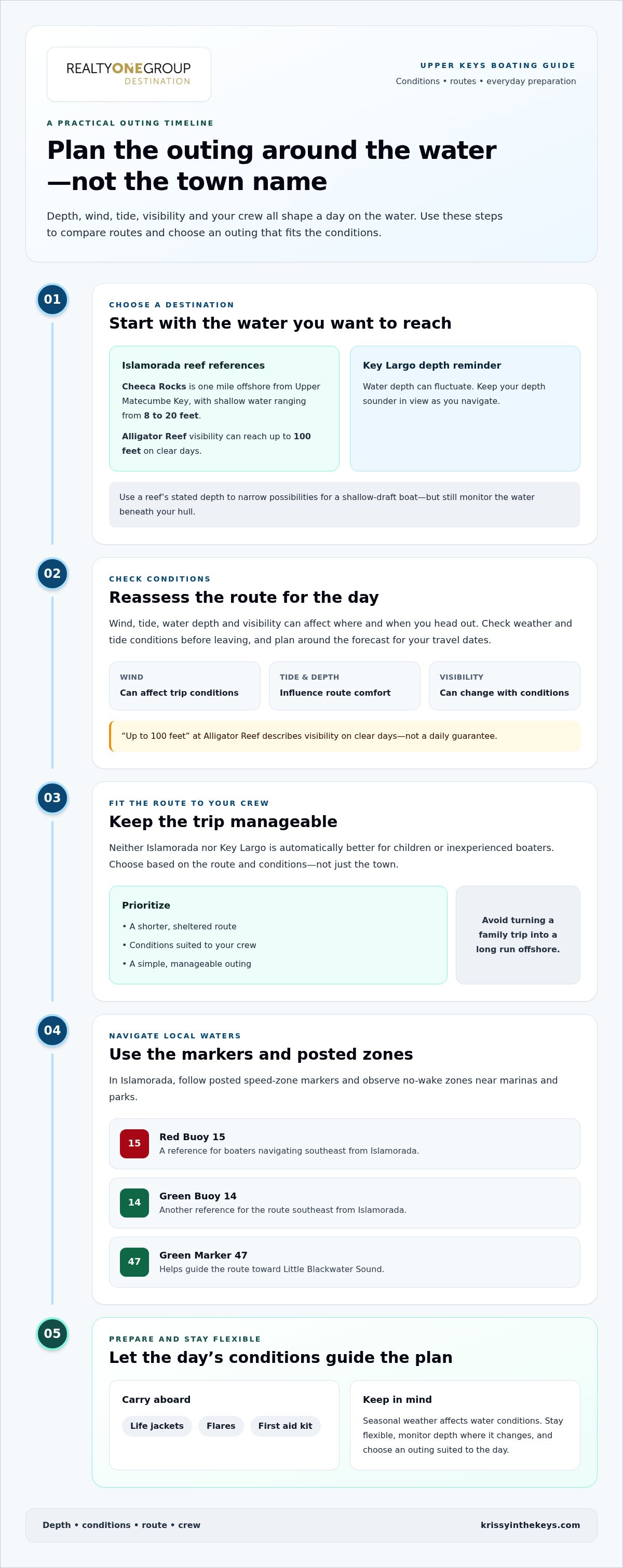
Water depth and visibility vary by route, so compare specific destinations rather than judging either town as a whole. At Islamorada’s Cheeca Rocks, shallow water ranges from 8 to 20 feet. Alligator Reef visibility can reach up to 100 feet on clear days, offering striking views when conditions align. Those reef details may appeal to snorkelers, divers, and anglers choosing fishing grounds.
In Key Largo, pay close attention to water depth, which can fluctuate, and monitor your depth sounder as you navigate. Around both destinations, the route, tide, wind, and your boat’s draft affect how comfortable a trip feels. A reef location’s stated depth may help you narrow options for a shallow-draft boat, but it doesn’t replace monitoring the water beneath your hull.
Which destination is better for boating with children or inexperienced boaters? Neither is automatically the better choice. Prioritize a shorter, sheltered route and conditions suited to your crew, rather than choosing by town name. Keep the outing manageable and the route simple instead of turning a family trip into a long run offshore.
Changing wind, tide, and water depth can all affect a boating trip. Before leaving Islamorada, check the weather and tide conditions. Seasonal weather also affects conditions on the water, so plan around the forecast for your travel dates rather than assuming visibility or sea state will stay consistent. Carry life jackets, flares, and a first aid kit aboard.
For better visibility, plan reef outings around clear conditions and stay flexible. Alligator Reef’s visibility figure describes what can occur on clear days, not a daily guarantee. At Cheeca Rocks, shallow depths make it especially important to understand your route before departure. In Key Largo, keep an eye on your depth sounder as water depth changes. These steps can help families, new boaters, and fishing enthusiasts choose outings suited to the day’s conditions.
Islamorada boating lifestyle
Islamorada’s boating appeal extends beyond a single reef trip. Picture a regular day on the water: choose a fishing area, set a route, and decide whether the outing suits the conditions. Alligator Reef can serve as a familiar landmark, with its lighthouse rising 136 feet above the water. Built in 1873, it gives boaters a distinctive reference point when planning a trip around the reef. More than 500 marine species live in the surrounding waters, adding to the area’s appeal for people who enjoy observing marine life.
Cheeca Rocks, one mile offshore from Upper Matecumbe Key, is another destination to consider. To decide whether Islamorada or Key Largo is better for boating, start with the routine you want. Would you rather plan outings around Islamorada’s reefs and fishing, or prioritize another base’s access and attractions? Your usual destinations and preferred pace may reveal more than a town’s reputation.
Local navigation also shapes an Islamorada boating day. Follow posted speed-zone markers and observe no-wake zones near marinas and parks. Boaters navigating southeast from Islamorada should watch for red Buoy 15 and green Buoy 14. Green Marker 47 helps guide the route toward Little Blackwater Sound. These markers offer practical reference points as you plan your route and approach local waters.
To decide whether Islamorada or Key Largo is better for boating, compare the everyday experience you want, not just a list of destinations. Consider how often you’ll visit reefs, whether fishing is central to your plans, and how your intended route fits your routine. Then connect those preferences to the home base you’re considering. Islamorada may be a strong match if you want nearby landmarks and boating destinations to shape regular outings. A clear picture of your preferred day on the water can guide your decision.
Which has better boat ramps and public launch facilities, Islamorada or Key Largo?
There isn’t a single townwide winner for public boat ramps. The right launch depends on your boat, towing setup, and regular destinations. Compare the specific ramp you’d use in Key Largo with the one you’d use in Islamorada. Consider launch access, trailer maneuvering space, parking, and how directly each route connects with your planned waters.
Start with your boat and launch routine. A larger trailer needs room to turn and line up, while frequent fishing trips may make a direct route more important than nearby restaurants. Think through the full sequence: arriving with your boat, launching, parking, returning, and retrieving it. A ramp that works smoothly for that routine may suit you better than one closer to your lodging.
Next, map each launch against your destinations. For a Key Largo outing toward the Atlantic, consider the route from your selected ramp and the water depth along the way. For an Islamorada trip, identify your destination and route before choosing a launch. In either area, monitor your depth sounder as you navigate and observe no-wake zones near marinas and parks, including around John Pennekamp Coral Reef State Park.
If you’re comparing boating bases for a longer stay, distinguish public launch convenience from private dock access. A waterfront property’s water depth, fixed bridges, canal width, dockage, and proximity to open water all affect whether it suits your boat, even if a public ramp is nearby. Choose Key Largo or Islamorada by matching a specific launch point and property to your vessel and usual routes, rather than assuming one town’s ramps are better across the board.
For a boating-focused stay, compare available waterfront homes.
Krissy in the Keys (Krissy Carnahan, Realtor): Luxury Waterfront Home Sales
Krissy in the Keys (Krissy Carnahan, Realtor) can connect your boating priorities with your waterfront home search in Islamorada, Key Largo, and Tavernier. If you’re considering a home or vacation property, Buyer Representation for Luxury Estates can help you assess whether dockage, water depth, canal width, and the route to open water fit your plans. Sellers can turn to Seller Representation of Luxury Estates for specialized marketing and sales support.
Make a wish list to focus your search: note your boat’s size, preferred fishing areas, ocean or bay preference, and the routes you expect to take most often. These details can help narrow the search to properties that better match your boating lifestyle.
If you’re exploring waterfront homes in Islamorada, Key Largo, or Tavernier, contact Krissy in the Keys to connect your boating plans with a focused property search.
Choose the boating lifestyle that fits your next move
Choosing between Islamorada and Key Largo for boating also means choosing the home base you want for life on the water. Before deciding, write down your priorities: the routes you expect to take, the boat you plan to use, and the waterfront features that matter most. That list can turn a broad location comparison into a focused property search.
If you’re considering a waterfront home or vacation property, match your boating priorities to the property itself. Its setting should support how you plan to spend your time, not simply look appealing on a map. Krissy Carnahan can help you compare waterfront properties in Islamorada, Key Largo, and Tavernier with your boating plans in mind.
Thank you for reading. You’re welcome to get in touch and request a list of current homes on the market. A thoughtful next step can bring your boating plans and property search closer together.
Frequently Asked Questions
Which Is Better: Key Largo or Islamorada?
Key Largo may suit boaters whose plans center on John Pennekamp Coral Reef State Park, while Islamorada may appeal to those who want reef and fishing outings to shape their routine. To decide whether Islamorada or Key Largo is better for boating, start with the trips you expect to make most often, then consider which community’s everyday setting fits your stay or home search.
How do boating conditions compare between Islamorada and Key Largo?
Neither destination is consistently calmer or clearer: conditions vary by route and day. Wind and tide can affect Islamorada waters, while depth can fluctuate along Key Largo routes. Which is better for boating, Islamorada or Key Largo, partly depends on how you adapt your plans. Choose a suitable destination, monitor depth, and adjust your outing when conditions change.
How do shallow water, reefs, tides, and navigation hazards differ around Islamorada and Key Largo?
Islamorada’s Cheeca Rocks has shallow depths of 8 to 20 feet, while depths at Key Largo’s Molasses Reef reach 10 to 30 feet. Markers also differ by route: Buoys 21 and 23 guide boaters approaching Key Largo waters, while red Buoy 15 and green Buoy 14 are reference points southeast of Islamorada. Account for depth and tide as you navigate.
For personalized guidance on waterfront homes in Islamorada, Key Largo, and Tavernier, contact Krissy Carnahan to discuss your boating priorities and property search.


