

No Florida home can be made completely hurricane-proof, but a layered approach can reduce vulnerabilities. Understanding how to hurricane-proof a luxury home in the Keys starts with protecting every exterior opening using impact-resistant products or an approved opening-protection system. Resilient construction and careful attention to flood exposure and insurance add other important layers of preparation.
In the Keys, large windows, waterfront exposure, roof connections, and other property features all affect storm readiness. Impact windows can protect openings without shutters, while approved shutters offer another option, depending on the home’s design.
This guide explains how these protections work together, what to consider in hurricane-resistant construction, and how mitigation features may relate to insurance. It also covers why a property’s existing features matter when assessing a luxury home, whether you’re considering a purchase or planning ahead for a home you already own.
Key Takeaways
- Learn when impact windows may provide opening protection and why shutters can still be a useful part of a home’s storm-readiness plan.
- See how roof connections, construction materials, and available hardening support can shape a more resilient property.
- Understand why elevating electrical and HVAC equipment matters when considering flood exposure, insurance, and a home’s overall resilience.
- Thank you for reading. Reach out with questions or requests for clarification, or ask for a list of current homes on the market.
Do I need hurricane shutters if the property has impact windows?
In the Florida Keys, impact windows can protect openings without shutters, but approved shutters are another form of opening protection. The key is ensuring that every exterior opening has a suitable protective system.
Impact-Resistant Windows and Doors
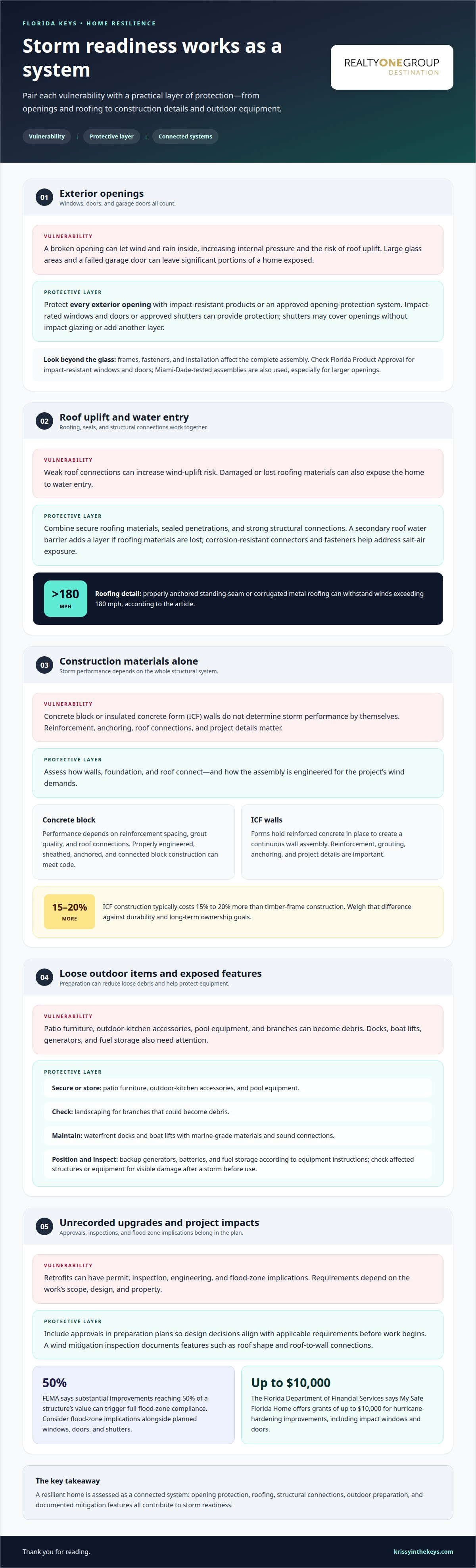
Impact-resistant windows and doors use glazing and frames designed to resist windborne debris during storms. They matter because a broken window can let wind and rain inside, increasing internal pressure and the risk of roof uplift. In a luxury home with broad glass doors or expansive windows, protection depends on the complete assembly, not the glass alone. Frames, fasteners, and installation all affect how the opening performs.
Opening Protection Beyond Glazing
Opening protection includes impact-rated windows and doors, as well as approved shutters that cover openings when needed. In the Florida Keys wind-borne debris region, every exterior opening must be impact-resistant or protected by an approved system. That includes garage doors, which can leave a large part of the home exposed if they fail. Shutters can protect openings without impact glazing or add another layer, but they don’t replace protection for other openings.
Impact Glazing and Code Requirements
Impact glazing is a window or door assembly designed to resist debris impact while remaining in its frame. For impact-resistant windows and doors in a Keys home, check Florida Product Approval. Miami-Dade-tested assemblies are also used in high-performing properties, especially for larger openings where wind exposure and product design affect performance. The Florida Building Code’s opening-protection requirements make it important to assess every exterior opening, rather than treating a few upgraded windows as whole-home protection.
Think beyond the glass when planning improvements. According to the Federal Emergency Management Agency, substantial improvements to a structure can trigger full flood-zone compliance when they reach 50% of the structure’s value. That threshold can affect renovation planning, so consider flood-zone implications alongside new windows, doors, and shutters.
Hurricane-resistant construction in the Florida Keys
Planning how to hurricane-proof a luxury home in the Keys means considering connected systems, not isolated upgrades. Roofing, fasteners, utilities, and outdoor features all affect storm readiness.
Wind-Resistant Roofing and Sealed Penetrations
A wind-resistant roof combines secure roofing materials, sealed penetrations, and strong structural connections. These details help limit wind uplift and water entry if debris damages roofing. Properly anchored standing-seam or corrugated metal roofing can withstand winds exceeding 180 mph. A secondary roof water barrier provides another layer if roofing materials are lost. In the Keys, corrosion-resistant connectors and fasteners also help address salt-air exposure.
Code Requirements and Retrofit Approvals
Code requirements, permits, and inspections help document how a retrofit meets project requirements. Monroe County permits and inspections depend on the work’s scope, and engineering needs depend on the design and property. A roof or structural change, for example, may require a different review from a minor repair. Include these approvals in your hurricane-preparation plans so design decisions align with applicable requirements before work begins.
Outdoor Features and Storm Preparation
Outdoor preparation helps limit loose objects and protect exposed features. Secure or store patio furniture, outdoor-kitchen accessories, and pool equipment, and check landscaping for branches that could become debris. Waterfront docks and boat lifts benefit from marine-grade materials and sound connections. Install and position backup generators, batteries, and fuel storage according to equipment instructions. Before a storm, secure outdoor items; afterward, look for visible damage before using affected structures or equipment.
Construction Features and Insurance Discounts
Certified hurricane-mitigation features can affect insurance assessments, and a wind mitigation inspection documents features such as roof shape and roof-to-wall connections. The Florida Department of Financial Services says My Safe Florida Home offers grants of up to $10,000 for hurricane-hardening improvements, including impact windows and doors. Owners considering how to hurricane-proof a luxury home in the Keys can factor these programs and documented features into improvement planning.
Concrete block and insulated concrete form construction
Concrete block and insulated concrete form (ICF) walls can create a sturdy structural envelope, but materials alone don’t determine storm performance. Reinforced concrete combines steel rebar and concrete, helping resist compression and tension. With concrete block, performance depends on reinforcement spacing, grout quality, and roof connections. Properly engineered, sheathed, anchored, and connected block construction can meet code and perform reliably in Florida’s coastal conditions.
ICF construction uses forms to hold reinforced concrete in place, creating a continuous wall assembly. Properly reinforced, grouted, anchored, and project-detailed ICF walls can perform well under a project’s wind demands. The foundation and roof connections must work with the walls as one system. ICF construction typically costs 15% to 20% more than timber-frame construction, so weigh that difference against durability and long-term ownership goals.
Location also shapes design. Seaward of the Coastal Construction Control Line, the lowest horizontal structural member must sit above the design flood level. Enclosed lower floors are limited to parking, storage, and recreational use. A monolithic slab is one foundation option; recommendations include concrete rated at least 3,000 PSI and #4 rebar spaced on 24-inch centers. A custom plan must account for the site’s flood exposure and structural demands.
These figures provide context, not a universal project budget: design, materials, site conditions, and selected features all affect costs. Long-term value also depends on how well the home remains functional after severe weather, not just whether one wall system resists failure.
Evacuation is another practical factor in the Florida Keys. Leaving the Keys can take 12-24+ hours because US-1 is the only road out. A robust structure can reduce some vulnerabilities, but it cannot remove evacuation constraints or replace an emergency plan. Consider construction choices alongside the property’s location, access, flood exposure, and the needs of the people who use the home.
Do Hurricane Resistant Homes Save Money on Insurance?
Certified hurricane-mitigation features can affect insurance premiums, while elevation and equipment placement shape flood exposure. Florida homeowners with certified mitigation features can qualify for annual insurance premium reductions of 25% to 45%. A home’s documented features, wind exposure, flood zone, and coverage choices all inform the insurance picture. A discount doesn’t remove the need to understand windstorm and flood coverage limits.
Elevation matters in the Florida Keys, where flood exposure varies by property. An elevation certificate and the home’s design flood elevation help show how the structure sits relative to expected flood levels. Coastal foundations must account for flooding, soil erosion, and saltwater. Engineered pilings can elevate a home, while the foundation design should also suit the property’s ground conditions and the structure it supports.
Elevating HVAC units and electrical panels above base flood elevation can reduce the risk of flood damage to essential systems. For an existing property, the equipment’s position relative to the finished floor and design flood elevation can help identify vulnerabilities. A reinforced foundation and a connected building envelope both contribute to resilience, but address different forces and risks.
Insurance costs and coverage limits depend on property-specific factors, including location, elevation, construction features, and selected coverage. Wind-mitigation documentation can record features insurers consider, while flood insurance addresses a separate exposure. For homeowners reviewing their coverage options and policy needs, resources like verdantinsurance.com offer guidance on securing appropriate home and property protection. During a purchase, these details help put a property’s resilience and ongoing ownership considerations in context. Buyers considering a Keys home can weigh its elevation, equipment placement, and documented mitigation features as part of their overall assessment.
Explore current Keys homes
Krissy in the Keys (Krissy Carnahan, Realtor): Luxury Waterfront Home Sales
Krissy in the Keys (Krissy Carnahan, Realtor) provides buyer representation for luxury estates and luxury waterfront home sales for people weighing a Keys property’s features, location, and ownership priorities. If you’re considering a purchase in Islamorada, Key Largo, Tavernier, or the Upper Keys, real estate guidance can help you assess how a home fits your plans alongside the resilience considerations covered here. Sellers can turn to Krissy for representation of luxury estates, while vacation property sales support buyers and sellers focused on a retreat or second home.
Every property has its own combination of waterfront setting, construction, and practical considerations. For help exploring a purchase or sale, contact Krissy in the Keys with questions or requests for clarification. Prospective buyers can also ask for a list of current homes available on the market. Thank you for considering Krissy in the Keys as you plan your next step.
Shape Your Next Keys Property Decision
Planning how to hurricane-proof a luxury home in the Keys is also a property decision. The home’s features should suit how you plan to live, use, and care for it. Whether you’re considering a purchase or sale, clarify your priorities and assess the property as a whole. This perspective can help you decide which questions to address before your next step.
Krissy in the Keys supports buyers and sellers across Islamorada, Key Largo, Tavernier, and the Upper Keys. Reach out to discuss your real estate plans, whether you’re exploring a property or preparing for a sale. Personalized guidance can help you make a considered choice that reflects your priorities and plans for life in the Keys.
As you plan your next step, Krissy in the Keys can help you explore the properties and lifestyle available in the Florida Keys.
Frequently Asked Questions
Is any home in Florida truly hurricane-proof?
No home can be guaranteed to withstand every hurricane and its effects. A home’s design may reduce specific vulnerabilities, but wind, debris, and flooding affect properties differently. For example, a strong structural system doesn’t eliminate flood exposure. Assessing the whole property, including its location, construction, and upkeep, gives a more realistic picture than relying on a single feature or label.
Should You Retrofit an Older Home or Build New?
Choose based on the home’s condition, existing construction, and the improvements needed to meet your goals. Retrofitting may suit a home whose key components can be strengthened without extensive reconstruction. Building new allows resilience features to be planned together from the outset. For an older property, evaluate the roof, structural connections, openings, elevation, and renovation scope rather than deciding based on age alone.
What Construction Methods Make a Home Hurricane Resistant?
No construction method offers a standalone guarantee. Reinforced concrete block and insulated concrete forms are possible wall systems, but the design must also connect the roof, walls, and foundation. A strong wall may still be vulnerable if its roof connection is weak. The site’s wind and flood exposure, along with the design and quality of construction, all influence how the completed home performs.
What is the FORTIFIED Home standard and is it worth paying for?
FORTIFIED Home is a resilience standard for homes, updated at the start of 2025. Whether pursuing it makes sense depends on a property’s current features, planned improvements, and the value you place on a documented approach to resilience. Consider how the standard fits your ownership plans and the home’s overall construction. A designation shouldn’t be treated as a guarantee of lower insurance premiums.
What Florida building codes and Monroe County requirements apply to hurricane-resistant homes in the Keys?
New construction in the Florida Keys follows the Florida Building Code and Monroe County floodplain and coastal construction rules. Which requirements apply depends on the property and proposed work. A new build and a renovation can involve different considerations based on location and project scope. Code compliance establishes a required baseline; owners may also consider resilience features beyond that minimum.
What wind speed, flood zone, and storm-surge design standards apply to a luxury home in the Florida Keys?
Applicable wind and flood design criteria vary by property, so there isn’t one standard figure for every Keys home. Listed design wind speeds for Miami-Dade County and the Florida Keys are 175-185 mph. Flood planning considers the property’s elevation certificate and design flood elevation. A home’s setting and elevation help determine how wind and potential flooding shape its design considerations.
For guidance on buying or selling a property in Islamorada, Key Largo, Tavernier, or the Upper Keys, contact Krissy in the Keys to discuss your plans and questions.


